Compare football stadium tour Barcelona options during rebuild
The first thing to understand about any football stadium tour Barcelona offers right now is blunt: you are not touring the Camp Nou as supporters remember it. The old bowl is not a visitor attraction at the moment.
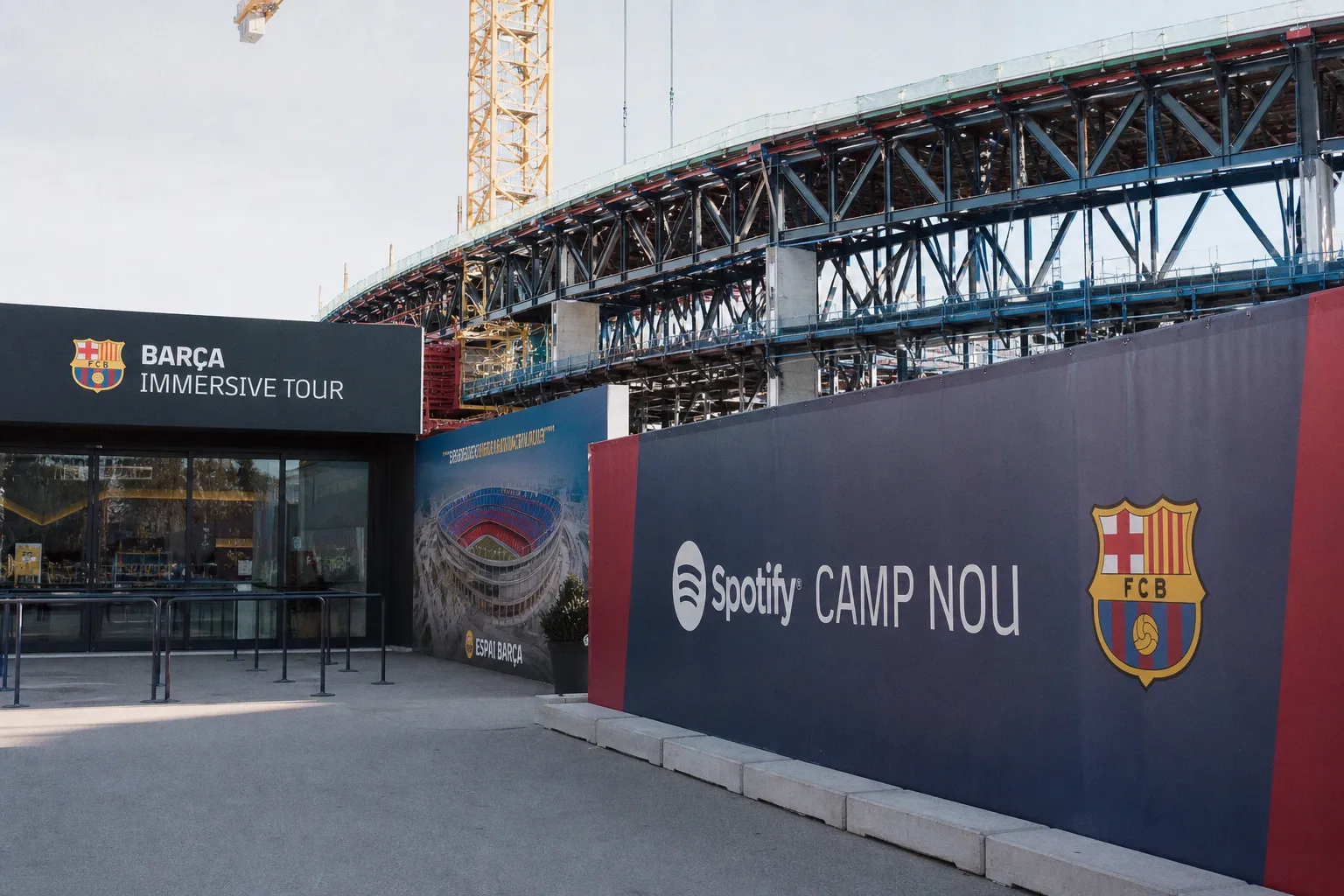
That distinction matters because Barcelona are still selling a stadium-adjacent experience, and many fans arrive expecting the classic sequence: tunnel, pitch edge, dressing rooms, dugout, panoramic stands. That product is effectively suspended. What exists now is the Barça Immersive Tour, staged in a temporary museum space next to the works, with a 360-degree audiovisual show and an exhibition explaining the future stadium. It is not fake. It is also not the old Camp Nou tour with a fresh coat of paint.
The Reality of the Current Barça Immersive Tour Experience
Barcelona have not stopped monetising the Camp Nou brand during reconstruction. They were never going to. A club carrying elite-level wage commitments, stadium debt, and a global tourism machine does not simply leave matchday nostalgia off the balance sheet for multiple seasons. The product has changed because the asset is being rebuilt, not because demand has disappeared.
The current offer is branded as the Barça Immersive Tour. It sits in a temporary museum space adjacent to the construction site rather than inside the working stadium bowl. That is the core commercial compromise: keep the international fan pipeline open, protect retail spend, and maintain the emotional link with the ground while the real estate is under heavy work.
What visitors get is essentially a controlled museum-and-media experience. The headline elements are:
1. A temporary museum route focused on club history, trophies, players, shirts, and the familiar institutional storytelling that Barcelona sell better than most clubs.
2. A 360-degree audiovisual show designed to simulate scale and emotion while access to the actual bowl is unavailable.
3. A construction exhibition explaining the Espai Barça project and what the renovated stadium is meant to become.
4. A retail-driven exit path, because no club with Barcelona’s financial pressures lets global footfall leave without passing merchandise.
That final point is not a cheap shot. It is the business model. Tours are not just cultural experiences; they are high-margin traffic funnels. The museum ticket is one line of revenue. The shirt, scarf, retro jacket, child’s kit and personalised print are the better margins. During a rebuild, that matters.
The current Camp Nou tour is not a stadium tour in the old sense. It is a holding product for a club keeping its global audience warm while the real stadium is rebuilt.
For supporters who have never been to Barcelona, the Immersive Tour still has value. It gives context, history and a packaged version of the club’s mythology. It is clean, efficient, and designed for visitors who want a Barça touchpoint during a city trip. For groundhoppers and stadium purists, the calculus is different. If your main reason for buying a ticket is to stand inside one of Europe’s great bowls, look at the fine print before you pay. The bowl is the missing piece.
This is where expectations become the real issue. The phrase “football stadium tour Barcelona” still pulls fans toward the old mental image of Camp Nou access. Barcelona’s current product trades on that memory, but it cannot deliver that geography. A museum next to a construction site is not the same as walking through the spine of a 99,000-capacity football cathedral.
Why the Main Stadium Bowl Remains Off-Limits to Visitors
The public explanation is construction. The private reality is risk, sequencing and liability. Once a stadium enters major demolition and reconstruction, visitor access stops being a hospitality question and becomes an operational problem. Insurance, contractor movement, restricted zones, temporary structures, heavy machinery, evacuation routes — none of that sits comfortably with tourists taking photos near pitch level.
Barcelona began the major demolition and reconstruction of the third tier in 2023 as part of Espai Barça. That is not cosmetic work. It is structural intervention on a stadium that is being repositioned as a larger, more commercially aggressive venue. The projected final capacity is 104,600. The aim is not simply to restore Camp Nou. It is to convert it into a higher-yield stadium platform.
That matters because modern elite stadium projects are not designed around romance. They are designed around:
- Premium seating and hospitality inventory, where clubs extract more revenue per seat than from standard admission.
- Year-round commercial use, not just 25 to 30 football dates.
- Retail, museum and tourist flow, which convert global support into predictable non-matchday income.
- Broadcast and sponsorship infrastructure, because naming rights, activations and partner visibility are now baked into the architecture.
- Operational segmentation, separating VIPs, general admission, media, players, staff and tourists more efficiently than older stadiums ever did.
The old Camp Nou was enormous, iconic and commercially under-optimised by current standards. That is the boardroom argument behind the rebuild. Supporters may frame it as heritage under renovation. Executives see a legacy asset with trapped revenue.
For visitors, the practical consequence is straightforward: there is no current access to the main stadium bowl for tours. No pitch walk. No dressing-room visit. No tunnel moment in the classic format. Any platform implying otherwise is either outdated, careless or leaning too hard on old inventory language.
| Visitor expectation | Current reality during rebuild | Commercial reason |
|---|---|---|
| Walk inside the Camp Nou bowl | Not available to the public for tours | Active construction zone and liability exposure |
| Visit dressing rooms | Not part of the current public tour | Internal stadium areas are unavailable during works |
| Stand near the pitch | Not available as a tour feature | The stadium is not operating as the old tour route |
| Learn about club history | Available through the temporary museum | Keeps tourism revenue moving |
| See the future stadium concept | Available through the construction exhibition | Builds support for Espai Barça and future ticket demand |
| Experience matchday scale | Simulated through audiovisual content | Substitutes media for physical access |
Barcelona are not unique here. Tottenham, Real Madrid, Bayern Munich and other major clubs have all treated stadium infrastructure as part of the commercial arms race. The difference is that Camp Nou carried a particular emotional weight. When that bowl is closed, the gap between brand promise and visitor reality feels bigger.
Inside the Espai Barça Construction Exhibition
The construction exhibition is the most honest part of the current offer. It tells visitors what the club is really selling: not memory, but future capacity, future comfort, future monetisation.
Espai Barça is the umbrella project for the redevelopment of the club’s facilities, with the stadium as the headline asset. The final renovated Camp Nou is projected to reach 104,600 capacity, making it one of the largest club stadiums in the world. Barcelona’s stated pathway includes returning with partial capacity during the 2024/25 season, around 60% initially, with the main stadium structure expected to be completed later, in 2026.
That timeline is not a promise to tourists that everything will feel normal quickly. Partial capacity means precisely that: a staged return, with sections, services and movement patterns likely to remain in transition. Anyone who has followed stadium builds knows the drill. Clubs communicate optimism; contractors manage reality; supporters discover the snag list on arrival.
The exhibition frames the rebuild as progress, and broadly it is. But the financial logic sits underneath every rendering. Barcelona need the renovated venue to work harder than the old one. A larger capacity matters, but capacity alone is not the whole business case. The premium mix, commercial areas, naming-rights value, and non-matchday usage are where the leverage sits.
The 360-degree audiovisual show does some of the emotional heavy lifting. It gives visitors scale, noise and spectacle when the physical stadium cannot. That format is useful for families and first-time tourists. It compresses the club’s identity into a digestible media experience. The danger is only in misreading it. It is an immersive presentation, not a substitute for the architectural experience of entering Camp Nou.
There is a similar pattern in how global institutions sell reputation while rebuilding or repositioning themselves. Universities do it through rankings, facilities and international branding; football clubs do it through stadium renders, museum routes and membership language. Even outside football, the logic of global prestige is easy to see in resources such as a ranking of the world’s best universities, where names, infrastructure and perceived status become part of the same market conversation.
Barcelona understand that market well. They are not merely a Catalan football club with a large ground. They are a global education in brand retention: keep fans emotionally invested, keep tourists circulating, keep sponsors visible, and keep the future product desirable before it exists in full.
Timeline for Returning to the Full Camp Nou Matchday Experience
The timetable is the part supporters want to simplify, and the part boards prefer to phrase carefully. Barcelona aim to return to the Spotify Camp Nou during the 2024/25 season with partial capacity, roughly 60%. Full completion of the main stadium structure is expected in 2026. The exact date for the return of a full traditional stadium tour — pitch access, dressing rooms and the classic internal route — remains subject to construction progress.
That caveat is not decorative. It is the whole story.
A partial stadium return does not automatically mean the old tour product returns on day one. Matchday operations come first. Safety certificates, crowd management, contractor access, broadcast demands and player facilities will outrank tourist routes. A club can host matches in a partially functioning stadium while still keeping large areas closed to visitors outside matchdays.
There are three likely phases, and fans should separate them rather than treating “Camp Nou reopening” as one clean switch.
Phase one: Museum-only continuity
This is the current reality. The Barça Immersive Tour keeps the club’s tourism product alive while the bowl remains closed. It is the safest and most controllable commercial offer. It also allows Barcelona to update the story as construction advances.
Phase two: Partial matchday return
Barcelona’s target is to return during the 2024/25 season at around 60% capacity. For supporters, this would restore the essential experience: watching a match at Camp Nou. But a partial matchday return is not the same as a fully restored visitor operation. Some concourses, access points, sightlines and services may still be temporary or constrained.
Phase three: Expanded stadium and full commercial relaunch
The main stadium structure is expected to be completed in 2026. That is the point at which the club’s full commercial stadium strategy should become clearer. The traditional tour may return in a new form, probably more segmented and more aggressively priced by access level. Expect the future product to distinguish between standard museum entry, stadium access, premium areas, matchday packages and hospitality-linked experiences.
The boardroom priority is not to recreate the old Camp Nou tour. It is to launch a more profitable one.
That is not cynicism for sport. It is how stadium economics works now. Clubs do not spend heavily on redevelopment to offer the same inventory at the same yield. A renovated Camp Nou with 104,600 projected capacity will be positioned as a modern commercial platform. The tour product will follow that logic.
Strategic Planning for Fans Visiting During the Transition Phase
For fans travelling to Barcelona during the rebuild, the sensible approach is to decide what kind of value they want. If the goal is club history, photography, merchandise and a controlled Barça experience, the current tour does the job. If the goal is stadium architecture, pitch proximity and the old Camp Nou feeling, patience may be the better purchase.
This is especially relevant for fantasy football and fan-culture audiences. The modern supporter experience is fragmented. Some fans follow Barcelona for history. Some for individual players. Some for tactical identity. Some through video games, fantasy formats, social clips and shirt culture. A museum-based tour can satisfy parts of that market without giving access to the pitch. The purist will still notice what is missing.
A practical comparison helps.
| Fan profile | Current Barça Immersive Tour fit | Better strategy |
|---|---|---|
| First-time tourist in Barcelona | Good enough if expectations are clear | Book it as a museum experience, not a full stadium tour |
| Groundhopper | Limited value | Wait for bowl access or combine with another live match in the city |
| Family with children | Stronger fit because of audiovisual content | Treat it as an indoor attraction with Barça branding |
| Long-time Barça supporter | Emotionally mixed | Go for the museum, but do not expect the old Camp Nou route |
| Architecture/stadium enthusiast | Weak fit | Delay until the renovated structure is accessible |
| Merchandise-focused fan | Good fit | Expect retail to be part of the route |
The biggest mistake is buying through habit. Camp Nou used to be one of Europe’s obvious stadium-tour stops. During reconstruction, it requires more due diligence. Not legal due diligence, not a 40-page procurement exercise — just a sober read of what is actually included.
There are several points fans should settle before booking:
1. Do not assume stadium bowl access. The current public experience does not include the main bowl. If that is the reason for your visit, the product will disappoint.
2. Treat “immersive” as media language. It means audiovisual presentation and exhibition design, not physical access to every famous area.
3. Check the date against construction milestones. A partial matchday return does not guarantee a full tour route.
4. Separate match tickets from tour tickets. A match at a partially reopened Camp Nou, when available, is a different proposition from the museum tour.
5. Budget for retail if travelling with children or shirt collectors. The exit through merchandise is not accidental.
6. Avoid outdated third-party descriptions. Some old tour language may still circulate online. The current reality is narrower.
There is also the question of opportunity cost. Barcelona is not short of football culture. If the Camp Nou bowl is the only thing you care about, then yes, the current tour is a compromised product. But if the broader purpose is to fold Barça into a city trip, the museum can still make sense. The value depends less on the ticket price than on expectation management.
From the club’s side, the current setup is rational. Barcelona preserve tourism revenue while protecting the construction schedule. They keep the brand visible. They educate visitors on the future stadium. They maintain a retail channel. None of this is sentimental, but it is coherent.
The same applies to communications around the rebuild. Public messaging will naturally lean on heritage, transformation and supporter experience. The numbers tell the harder story: approximately 60% initial capacity on return, 104,600 projected final capacity, and 2026 as the expected completion point for the main stadium structure. That is a phased asset recovery, not a simple reopening ceremony.
What the Rebuild Means for the Future Tour Product
The eventual full football stadium tour Barcelona sells after the rebuild will probably not be a straight restoration of the pre-construction route. It would be surprising if the club failed to use the renovation to reset the product ladder.
Expect a more deliberate split between standard and premium access. That is where European football has been moving for years. The stadium tour used to be a single mass-market product: pay, enter, follow the route, exit through the shop. The future model is more likely to resemble airline pricing or hospitality segmentation. Standard access for volume. Premium access for margin. Exclusive zones for higher spend. Bundles for international visitors. Add-ons for photo moments, museum extras and matchday adjacency.
Barcelona have the global demand to support that. They also have the financial incentive. The club’s public love affair with its supporters does not cancel the spreadsheet. It never has. The rebuilt Camp Nou will need to justify its cost through higher yield across matchdays and non-matchdays alike.
That should interest fantasy and fan-culture readers because the stadium is no longer just where football happens. It is where the club converts attention into money. A supporter who watches La Liga highlights in Jakarta, buys a shirt in Dublin, captains a Barça forward in a fantasy format, and visits the museum once every decade is still part of the same revenue ecosystem. The stadium tour is one touchpoint in that chain.
The irony is that the temporary Immersive Tour may be the clearest version of modern football’s business model. Strip away the grass, the seats and the tunnel, and what remains is brand, archive, screen, shop and future sales pitch. That is not an insult. It is the industry being honest by accident.
For now, the fair verdict is narrow. If you are searching for a football stadium tour Barcelona can currently provide, the Barça Immersive Tour is the active option. It gives history, media, and a view of the redevelopment narrative. It does not give the full Camp Nou. The main bowl remains closed to public tours because Espai Barça is still being built.
The likely boardroom outcome is predictable. Barcelona will keep selling the temporary experience until the stadium can safely generate more lucrative access. Then the club will relaunch the tour not as a nostalgic return, but as a premiumised product inside a bigger commercial machine. Fans may hope for the old Camp Nou back. The club are building the next balance sheet.