Compare Player Stats for FPL Transfer Decisions
In the 63rd minute of a Premier League match, the FPL picture can change more sharply than the scoreline.
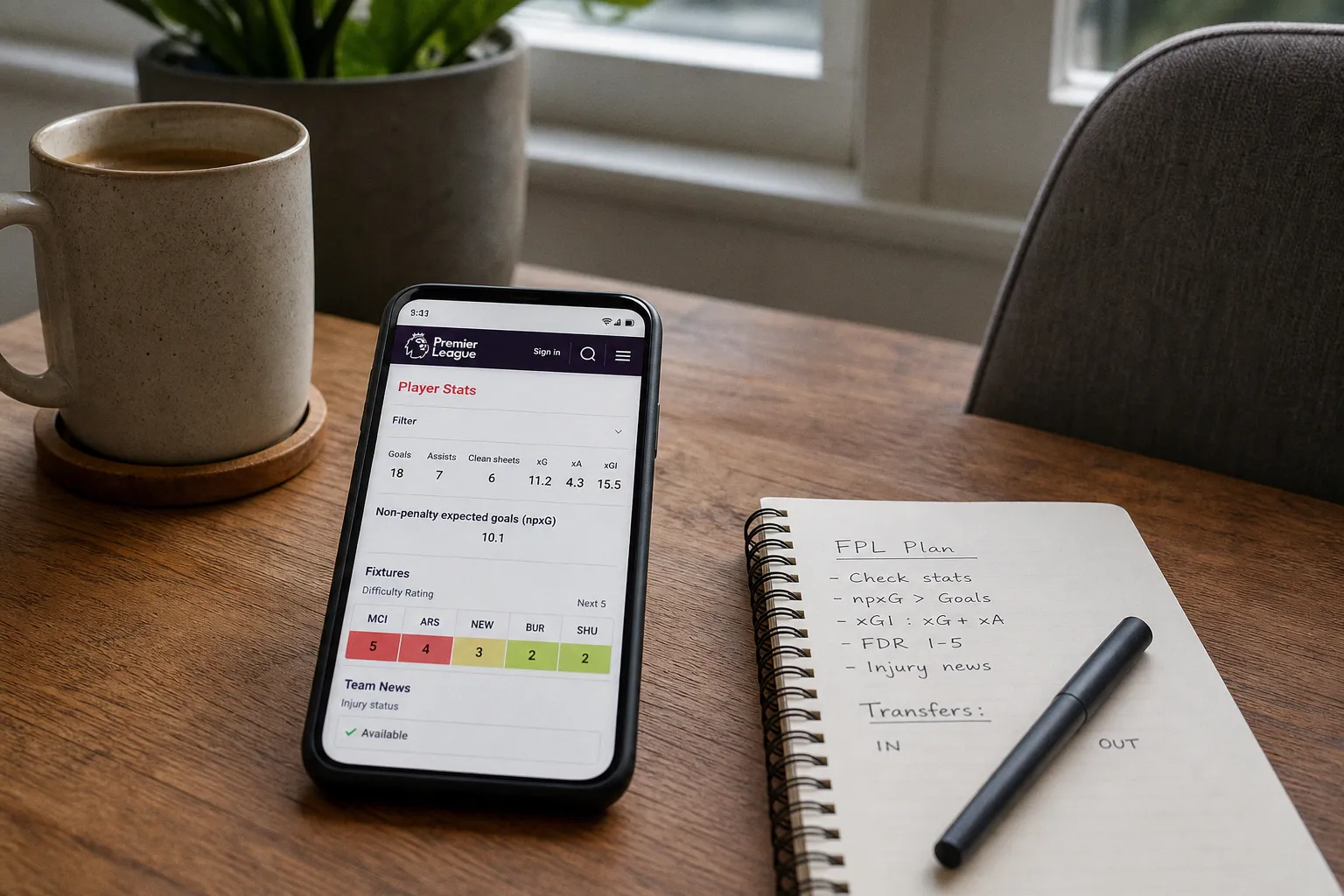
That is the core problem behind how to check compare player stats for FPL transfer decisions: managers are not simply choosing between two names on a transfer screen. They are weighing role, minutes, shot quality, creative volume, fixture sequence, and injury risk inside a league where one touchline adjustment can move a player from peripheral runner to primary outlet. The best FPL decisions are rarely built on last week’s points alone. They come from reading the evidence before the wider market catches up.
Moving Past Raw Totals: Why xG and xA Reveal True Form
The Premier League table has a way of exposing teams over months; FPL exposes assumptions over weekends. A midfielder can score from his only shot, collect a bonus-point haul, and become the most transferred-in player by Monday morning. Another can miss twice from central positions, create three chances, take corners, and finish with two points. One has rewarded the past. The other may be telling you something about the future.
This is where expected goals and expected assists become more than analyst vocabulary. xG measures the quality of a shot based on factors such as distance, angle, and the type of assist. xA measures the likelihood that a pass becomes a goal assist. Neither guarantees returns, and that distinction matters. They do not tell you what will happen next Saturday. They tell you whether a player is consistently getting into, or creating, the type of situations that usually produce points.
For FPL transfers, the first comparison should be between output and underlying process:
| Player profile | Raw points signal | Underlying data signal | Transfer reading |
|---|---|---|---|
| Scored from low shot volume | Strong last week | Weak xG, few touches in box | Watch, do not chase blindly |
| Blank but high xG | Poor last week | Repeated good chances | Potential buy before price movement |
| Assist from one set-piece | Useful return | Low xA from open play | Fixture and role dependent |
| No return but high xA | Underwhelming score | Regular chance creation | Strong for midfield comparison |
| High points, reduced minutes | Attractive total | Subbed early or rotation risk | Needs team-news caution |
The official Premier League player statistics offer the necessary baseline: goals, assists, clean sheets, and expected metrics such as xG and xA. The baseline matters because it keeps the comparison anchored in verified data rather than weekend noise. But the interpretation is where the transfer edge sits.
A forward with four goals from limited xG may still be an excellent asset if he is secure for 90 minutes, on penalties, and leading a side with improving fixtures. But if his non-penalty shot profile is thin and his next opponents compress space well, the total can become a trap. The manager who bought the headline may be paying for a run already priced into the market.
FPL is not a search for the player who just scored. It is a search for the player whose role makes the next return more likely than the market believes.
The same applies to creative midfielders. Assists are often unstable because they depend on the finisher. Minutes per chance created is a cleaner way to see whether a player is repeatedly supplying danger. If a midfielder creates a chance every half-hour and also carries some xG of his own, he is not merely a passer in a neat side. He is part of the attacking hierarchy.
The Predictive Power of Non-Penalty Expected Goals
Penalties are valuable in FPL, and ignoring them would be careless. The penalty taker in an attacking side always carries a premium because one box entry, one late tackle, one VAR intervention can swing a gameweek. But when comparing forwards and attack-minded midfielders, non-penalty expected goals — npxG — is often the better measure of repeatable threat.
The reason is simple enough: penalties can inflate a scoring record and distort the eye. A forward may sit high in the goals column because he has converted spot-kicks, while another has repeatedly produced open-play chances of better long-term value. In a transfer market shaped by ownership and price rises, that difference is not academic. It is the margin between buying a sustainable role and buying a temporary headline.
A practical comparison should separate the sources of threat:
1. Open-play shot quality. Is the player receiving chances centrally, or taking speculative efforts from distance? A rising xG built on close-range attempts has a different meaning from a volume of low-percentage shots.
2. Penalty dependency. If a large share of a player’s appeal comes from spot-kicks, check whether the open-play numbers still justify the price.
3. Position within the team structure. A striker in a side that creates cut-backs and early crosses may have a stronger floor than a forward relying on transitions alone.
4. Minutes security. A player producing strong npxG in 55-minute appearances is interesting, but the transfer decision changes if he is consistently replaced before the match opens up.
5. Route to bonus points. Shots on target, winning goals, and overall involvement can help forwards convert returns into larger hauls, but only if they remain central to the attacking plan.
The press-box view often gives this away before the data table does. A manager’s reaction when a player fails to press, the assistant’s instruction after a turnover, the full-back’s average height: these details show whether the player is trusted to stay in the system. FPL managers do not have to overcomplicate it, but they do need to ask whether the player’s numbers are attached to a stable role.
Consider two forwards at the same price. One has scored twice in two weeks, both from penalties, with limited open-play involvement. The other has blanked twice but recorded several good non-penalty chances and played 85-plus minutes in both fixtures. The first may rise in price faster. The second may be the better transfer. Momentum in FPL is not always the same as momentum on the pitch.
Integrating Fixture Difficulty Ratings into Your Transfer Logic
Fixture Difficulty Rating, usually presented on a 1-to-5 scale, is one of the most useful tools in FPL and one of the easiest to misuse. A green run is not a licence to buy any attacker from a mid-table side. A red fixture is not an automatic sell if a player’s role is strong enough to travel.
The better question is not “Are the fixtures good?” It is “Do the fixtures suit this player’s route to points?”
A winger who depends on isolation against a slow full-back may look excellent in one supposedly difficult match and poor in an easier game against a deep block. A striker who thrives on crosses may benefit when facing opponents who concede wide territory. A creative midfielder may be more valuable against teams that leave space between midfield and defence than against sides that defend the penalty area in a low, narrow line.
That is where FDR must be integrated with the player’s statistical profile:
| FDR context | Player type helped | Player type at risk | FPL action |
|---|---|---|---|
| Easier fixtures against open defences | Runners, wide forwards, advanced No 8s | Deep creators with low box threat | Buy or hold attacking assets |
| Easier fixtures against low blocks | Set-piece takers, penalty-box strikers | Transition-only wingers | Compare xA and shots in box closely |
| Hard fixtures against high lines | Fast forwards, direct wingers | Static penalty-area forwards | Do not sell automatically |
| Hard fixtures against possession-heavy sides | Counter-attacking outlets | Full-backs reliant on clean sheets | Attack may still be viable |
| Congested schedule | Nailed starters with high fitness trust | Rotation-prone attackers | Prioritise minutes over ceiling |
This is also where broader football awareness helps. A club may have a friendly FDR run on paper but be in a tactical transition after a managerial change, a midfield injury, or a shift to a back three. In that moment, old player roles can become unreliable. The right wing-back is no longer just a defender. The No 10 may become a second striker. The centre-forward may be asked to press and occupy centre-halves rather than attack the six-yard box.
FPL transfer strategy should reflect that hierarchy of information. Fixtures matter, but fixtures are filtered through role. Role is filtered through minutes. Minutes are filtered through manager trust.
For managers who follow the Premier League alongside wider daily coverage, it is sensible to keep general news habits separate from FPL decision-making; a broad outlet such as Nevla News can sit in that wider reading routine, but transfer choices still need to come back to football-specific evidence: team news, usage, and underlying numbers.
Expected Goal Involvement: The Cleaner View of Attacking Weight
Expected Goal Involvement, or xGI, combines xG and xA. It is one of the cleanest measures for comparing attackers across positions because it captures both shooting and chance creation. In FPL terms, it answers a more complete question: how often is this player involved in the actions most likely to become goals?
This is particularly useful when comparing midfielders. Some midfielders are finishers in disguise, arriving late into the box and taking high-value shots. Others are supply lines, producing xA through through-balls, cut-backs, and set-pieces. A few are both, and those players tend to become season-defining assets when the minutes hold.
The mistake is to treat xGI as a single ranking table without context. A high xGI forward and a high xGI midfielder do not carry identical value because FPL scoring differs by position. Midfielders receive more points for goals and can collect clean-sheet points. Forwards may have a clearer route to repeated chances but less scoring protection when they blank. Defenders with attacking xGI, especially set-piece threats and advanced full-backs, add another layer because clean sheets remain part of the calculation.
A sensible xGI comparison asks five questions:
1. Is the xGI recent or season-long? A four-game surge may signal a role change, but it may also be a short run of favourable match states.
2. Is the player’s team improving creatively? Individual numbers are stronger when the whole attacking structure is moving in the right direction.
3. Is the xGI balanced? A player with both xG and xA has more routes to points than one who relies on only one channel.
4. Does the price reflect the role? Premium assets need captaincy potential or exceptional reliability. Budget assets only need to outperform their bracket.
5. Are minutes rising or falling? No metric survives repeated 60-minute withdrawals without adjustment.
The most valuable FPL asset is not always the most explosive. Often it is the player whose involvement survives different match states. When his side leads, he still carries counter-attacking threat. When his side trails, he remains on set-pieces and receives more touches near the box. When the manager changes the shape, he stays on the pitch. That kind of stability does not trend as loudly as a hat-trick, but over a six-game transfer horizon it can define rank movement.
The best transfer is rarely a reaction to one return. It is a bet that a player’s place in the attacking structure is becoming harder for his manager to disturb.
Minutes, Touchline Trust, and the Rotation Problem
FPL managers often talk about “nailed” players as if selection were a permanent condition. It is not. Selection is a weekly negotiation between performance, fitness, opponent, schedule, and the manager’s tolerance for risk. A player can be first choice in September and a managed asset by December. He can be protected after European nights, shifted wide to accommodate a returning teammate, or withdrawn early because the manager wants more defensive control.
That is why minutes played sit alongside xG, xA, and FDR as a primary transfer metric. A player cannot return from the bench with the same reliability as one starting and finishing matches. The final half-hour of Premier League games is often where FPL points are made: tired full-backs, stretched midfields, late penalties, set-piece pressure. If your transfer target rarely reaches that phase, his ceiling is being quietly capped.
When comparing two options, the minutes pattern should be read with the same seriousness as the goal column:
- Starts are stronger than appearances. A run of cameos can flatter form if returns arrive against tired opponents, but it rarely provides dependable FPL value.
- Substitution timing matters. Regular withdrawals around 60 minutes reduce exposure to late attacking phases and bonus-point accumulation.
- European involvement changes the equation. Champions League and Europa League schedules often bring attrition; managers protect key players before and after midweek fixtures.
- Competition for the same role is a warning. A fit teammate returning from injury can alter the hierarchy even if your player has recently returned points.
- Manager comments help, but actions matter more. Press conferences can be careful. Repeated selection patterns are harder evidence.
This is where watching matches still matters. Data can tell you a player was removed after 64 minutes. The match context tells you whether he was exhausted, ineffective, on a booking, returning from injury, or simply sacrificed after a red card changed the structure. Those are very different signals.
For defenders, minutes security carries another dimension. A centre-back who starts every week in a defensively stable side may be less glamorous than an attacking full-back with higher xA, but clean-sheet exposure has value. Conversely, a full-back posting strong creative numbers but facing rotation because of workload may become a transfer that looks better in a dashboard than in a starting XI.
Navigating Injury Reports and Team News for Tactical Stability
Injury news is where FPL certainty often breaks down. Official Premier League team news categories — such as Available, Doubtful, or Injured — are useful, but they should not be stretched beyond what they say. A doubtful player is not a confirmed absence. An available player is not guaranteed to start. Recovery timelines are often speculative until a club press conference or confirmed team sheet narrows the picture.
The key is to separate injury status from tactical stability. A player returning from a minor issue may be available, but his minutes could still be managed. A teammate’s injury may increase his role. A captain’s return may change set-piece order, pressing structure, or penalty hierarchy. FPL managers who treat team news as a binary available/unavailable question miss the deeper consequence.
Before making a transfer close to deadline, the practical order should be:
1. Check official team news. Use the Premier League’s injury and availability updates as the baseline rather than relying on rumour.
2. Read the manager’s wording carefully. “In contention,” “back with the group,” and “ready to start” are not the same phrase.
3. Consider the next fixture’s timing. A player returning three days before a match may be handled differently from one with a full training week.
4. Wait for confirmed line-ups when possible. Official team sheets are released one hour before kick-off; for early matches, that can prevent a costly move.
5. Assess the replacement chain. An injury to one player may not simply promote the obvious deputy; it may reshape the team.
This matters particularly in the premium bracket. If a high-priced midfielder is carrying a knock, the question is not only whether he plays. It is whether he plays wide instead of central, whether he loses set-pieces, whether he is removed early, and whether his side’s attacking rhythm changes without a regular full-back or striker. Transfer decisions at that level are not just about availability. They are about opportunity cost.
There is also a discipline issue around leaks and speculation. FPL is now a market of rapid reactions, and price changes can push managers into early moves. But an early transfer for a player with unresolved team-news risk can create a second problem before the gameweek even begins. Sometimes the strongest move is not speed; it is waiting until the hierarchy is clearer.
Building a Transfer Comparison That Actually Holds Up
The most reliable FPL transfer decisions come from layering information, not from finding one perfect metric. xG without minutes is incomplete. FDR without role is blunt. xA without finishing context can mislead. Injury news without tactical reading is thin.
A useful comparison between two players should look something like this:
| Question | Why it matters | Stronger signal |
|---|---|---|
| Who has better xGI? | Captures shooting and creative involvement | Repeated involvement over several matches |
| Who has stronger npxG? | Shows open-play scoring threat | Central chances, not speculative shots |
| Who plays more minutes? | More time means more routes to returns | Regular starts and late-game exposure |
| Whose fixtures suit his role? | FDR must match playing style | Opponents vulnerable to his main threat |
| Who has better team stability? | Injuries and rotation affect supply | Settled structure and secure role |
| Who offers better value? | Price shapes expectations | Underlying numbers above price bracket |
The point is not to make FPL mechanical. Football remains too fluid for that. A red card can destroy a plan. A deflected shot can reshape the bonus points. A manager can make a surprising substitution and reveal a new hierarchy on the touchline. But strong process reduces the number of transfers made in anger, and over a season that is a serious advantage.
For those asking how to check compare player stats for FPL transfer decisions in world football terms, the Premier League remains unusually data-rich and tactically transparent. The official player statistics provide the starting point. Advanced metrics refine the picture. Fixture difficulty gives the schedule context. Team news protects the decision from avoidable risk. The rest is judgement: understanding whether the number reflects a real role on the pitch.
The transfer market punishes managers who buy only what has already happened. It rewards those who notice when a player’s usage, fixtures, and underlying threat are beginning to align. That alignment is rarely loud at first. It may appear as a blank with high xG, a midfielder creating chances without assists, or a forward whose npxG is rising before the goals arrive. By the time the points become obvious, the price, ownership, and momentum may already have moved.
FPL is a season of small edges under constant attrition. The managers who hold their nerve through one blank, avoid chasing every haul, and compare players by role rather than reputation are usually the ones better placed when the table begins to settle. Raw points tell you who won last weekend. The right stats, read in context, tell you who is being positioned to matter next.