Football formations numbers: From rigid lines to fluid play
Football formations numbers once described fixed jobs, fixed zones and, in many cases, fixed shirt numbers. A 2-3-5 meant two defenders, three half-backs and five forwards. The arithmetic was the system.
It also became the language through which supporters understood who was supposed to be where.
That language still survives on television graphics, team sheets and tactical whiteboards. But it is no longer a complete description of a football team. A modern side announced as a 4-3-3 may defend in a 4-5-1, build in a 3-2 shape and attack with five players on the last line. The public formation is often a convenient label; the private tactical plan is a sequence of phase-specific arrangements.
That distinction matters. Formation numbers are not a historical curiosity. They determine recruitment profiles, wage structures, transfer priorities and the leverage a manager has in a boardroom. A club can call itself a 4-3-3 club all summer. If its coach requires a left-back who can become a central midfielder, it is not shopping for a conventional left-back. It is shopping for an expensive specialist, and the market will price him accordingly.
The Pyramid: when numbers really did mean positions
The original reference point is the 2-3-5, known as the Pyramid. It was an aggressively front-foot structure: two full-backs behind three half-backs, then five attackers spread across the pitch. Its purpose was not defensive caution. It was to place bodies high, dominate territory and overload an opponent with a line of forwards.
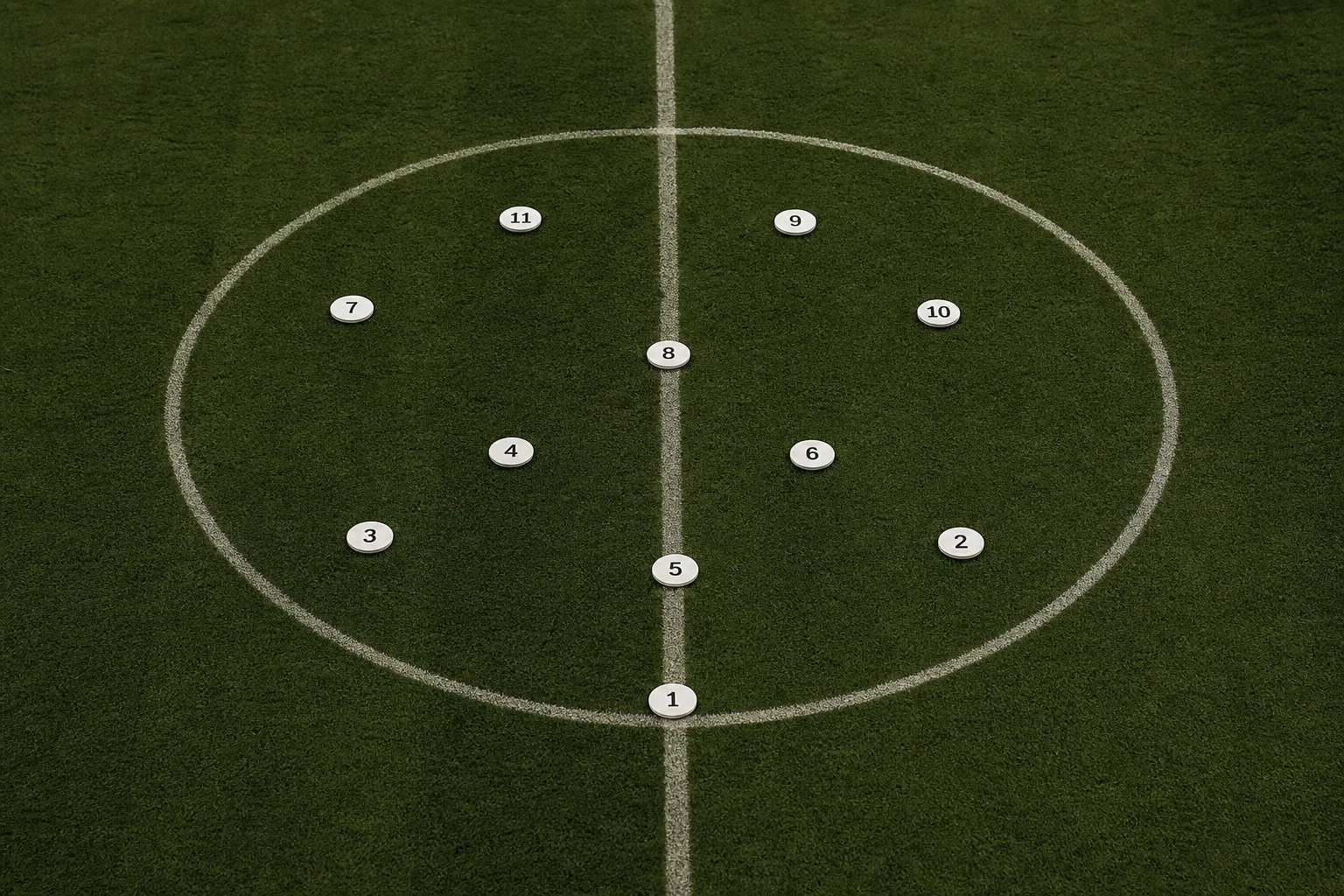
The familiar 1–11 shirt-number convention emerged from this geometry. Players were numbered from right to left:
| Shirt number | Traditional 2-3-5 role | Broad modern equivalent |
|---|---|---|
| 1 | Goalkeeper | Goalkeeper |
| 2 and 3 | Right and left full-back | Full-back or wing-back |
| 4, 5 and 6 | Right-half, centre-half, left-half | Midfielder, centre-back or holding midfielder |
| 7 and 11 | Outside-right and outside-left | Winger or wide forward |
| 8 and 10 | Inside forwards | Advanced midfielder or second striker |
| 9 | Centre-forward | Centre-forward |
The first professional English league matches with numbered shirts were played on 25 August 1928, including Arsenal against Sheffield Wednesday and Chelsea against Swansea Town. Numbering was still treated as a practical identifier rather than a branding asset. The shirt told the crowd what job a player had been selected to do.
The 1933 FA Cup Final made the idea more visible. Everton wore 1–11; Manchester City wore 12–22 in a numbering trial. The following season, numbering became mandatory. That is the point at which formation and identity became publicly intertwined.
The legacy remains stubbornly durable. A No. 9 still suggests the focal striker, even if he spends half the match dropping between lines. A No. 10 still signals creative licence, even when the player is effectively a pressing forward. The market exploits these labels ruthlessly. “Natural No. 6” is one of football’s most useful sales pitches because it sounds precise while covering several very different profiles.
Formation numbers began as a map of labour. Modern football keeps the labels but renegotiates the labour every time possession changes.
The offside change and the migration of No. 5
The evolution of football formations accelerated after the 1925 offside-law change. With fewer defending players needed between an attacker and goal, teams had to protect central areas differently. Herbert Chapman’s WM, usually expressed as 3-2-2-3, became the influential response.
The central half-back, traditionally No. 5, dropped deeper into the defensive line. In tactical terms, he moved from midfield traffic controller to centre-back. In cultural terms, a number that had once represented the middle of the pitch became associated with central defence in Britain.
This is why English football retains some numbering habits that can confuse viewers raised on continental or South American conventions. A British No. 5 is often a centre-back. A British No. 4 can be either a central defender or a holding midfielder, depending on the era and club. The numbering system did not become incoherent. It became a record of tactical change.
The 4-4-2 then simplified the visual language again. Two full-backs, two centre-backs, a midfield four and two forwards gave coaches clear lines of responsibility. It also suited the industrial logic of squad building: specialists could be recruited for recognisable departments, and substitutions were generally like-for-like.
That world is gone at elite level. The financial stakes are too high to carry a squad full of narrow specialists, while the physical demands of pressing and transition punish static roles. Clubs now seek players who solve multiple problems without forcing a wholesale change in shape.
A centre-back who can defend wide is not merely a tactical luxury. He protects the value of an attacking full-back. A midfielder who can receive under pressure lowers the need for a second specialist pivot. A winger who can press inside may allow a team to defend in a compact 4-4-2 without buying a separate wide midfielder. Follow the money and the tactical logic becomes clearer.
Why a No. 5 in Argentina is not a No. 5 in England
The meaning of soccer formation numbers was never universal. The sport globalised; its tactical vocabulary did not fully standardise.
Argentina provides the clearest contrast with England. In the 4-3-3 associated with its 1978 World Cup-winning side, No. 5 was the central defensive midfielder, while Nos. 2 and 6 were the centre-backs. In that football culture, “the five” commonly means the player screening the defence, setting the rhythm and protecting the middle during transitions.
For an English audience, that can sound upside down. A traditional English No. 5 may be the defender being screened. Neither convention is wrong. Each follows its own tactical lineage.
The same ambiguity applies to other numbers:
- No. 4 can mean a centre-back, a holding midfielder or a hybrid who steps into midfield during build-up.
- No. 6 is commonly the deepest midfielder in modern European discourse, but in Argentine numbering it has often been a centre-back.
- No. 8 once described an inside forward in the old Pyramid and now usually means a two-way midfielder operating between boxes.
- No. 10 remains football’s most romanticised number, though elite teams increasingly demand that its wearer presses, covers passing lanes and arrives in the box rather than simply “creates.”
- No. 11 has travelled from left-sided forward to winger, wide forward and, in some inverted systems, a player who spends more time in the half-space than on the touchline.
This is more than a terminology dispute. It affects scouting reports and transfer narratives. An agent pitching a South American “No. 5” to an English club is not selling a shirt number. He is selling a role. The buying club needs to ask whether that role fits its defensive rest structure, not whether the player resembles an old domestic stereotype.
The public version of recruitment tends to reduce this to positions: centre-back, left-back, striker. The private version is more exacting. Can the defender cover a 40-metre channel when the full-back inverts? Can the midfielder protect the centre alone when both eights push forward? Can the striker press the goalkeeper, then still lead the line after 70 minutes? Those questions decide whether a transfer is viable. The graphic on launch day does not.
A formation is now two formations, sometimes three
The most misleading question in modern analysis is: “What formation did they play?” It assumes a single answer.
The useful answer begins with possession. A team’s out-of-possession shape may be a compact 4-4-2 or 4-5-1, built to close the centre, restrict progressive passes and dictate where the opponent can play. Once the ball is recovered, the same team can spread into a 3-2-5 or 2-3-5 within seconds.
The numbers describe lines, not personalities. In a 3-2-5:
- the three form the rest defence, holding enough structure behind the ball to stop a counterattack;
- the two provide circulation and cover in central midfield;
- the five occupy the width and half-spaces across the final third, stretching the opposition’s back line.
The five attacking lanes are the commercial core of the system as much as the tactical one. Width pins full-backs. Occupation of both half-spaces creates decisions for centre-backs. A central forward fixes the defensive line. The team is trying to create a free player without surrendering control of the next transition.
Pep Guardiola has made the logic familiar, while Xabi Alonso’s Bayer Leverkusen offered a particularly clear recent illustration. The system used wing-backs Alejandro Grimaldo and Jeremie Frimpong as major attacking weapons, not auxiliary defenders waiting for permission to cross. Their combined output across two seasons was reported at 92 goals and assists — an extraordinary return for players nominally listed in defensive positions.
That output did not come from simply “letting the wing-backs attack.” It came from the structure beneath them. Three players stayed positioned to manage the counter. Two occupied central support zones. The wing-backs could then arrive high and wide, or inside, with less fear of leaving the side exposed.
This is fluid football formations explained without the mystique: players are not free to roam; they are assigned different obligations in different phases. The flexibility is planned. The rotations are rehearsed. The apparent improvisation is usually the product of a training-ground script.
The modern 3-2-5 is not attacking chaos. It is risk management with five players placed as close to goal as possible.
Pressing triggers reveal more than the starting XI
A starting formation graphic is useful for perhaps the first minute. Pressing triggers reveal the actual system.
Take a nominal 4-3-3. Without the ball, the wide forwards may move inside to press centre-backs, leaving the full-backs apparently available. That is often deliberate. The pressing trap is designed to force the pass wide, where the touchline reduces options and the near-side full-back can jump aggressively.
The same side may drop into a 4-5-1 if the first press is bypassed. One winger joins the midfield line, the centre-forward stays higher and the team protects central access. The formation has changed, but no substitution has occurred and no player has abandoned his role.
A competent tactical analysis therefore tracks several separate questions:
1. What is the team’s first defensive shape? This establishes the pressing reference points: which player closes the centre-back, who protects the pivot, and where the trap is set.
2. What happens after the first line is beaten? Some teams retreat into a mid-block; others continue man-oriented pressure. This is where defensive distances become more revealing than the nominal formation.
3. How many players stay behind the ball in attack? A 3-2 rest defence and a 2-3 rest defence can both support five attackers, but they distribute counterattack risk differently.
4. Who provides width? If full-backs hold the touchline, wingers can enter central zones. If wingers stay wide, a full-back may invert. The numbers remain similar; the passing map does not.
5. Who arrives in the penalty area? This separates a side that merely circulates the ball from one that creates high-value chances. Expected-goals models tend to reward the latter, but only if the final occupation produces clean shots rather than blocked cut-backs.
This is also why coaching changes disrupt squads even when the new manager appears to use the same formation. Two coaches may both list 4-2-3-1. One wants his full-backs overlapping and his double pivot holding. The other wants one full-back inside, a centre-back pushed wider and the No. 10 acting as a second striker. Same label. Different recruitment bill.
The wing-back has become an asset class
The evolution of football formations has elevated the wing-back from an old-fashioned wide defender into one of the most expensive and difficult profiles to acquire.
A genuine wing-back must cover distance, defend one-versus-one in open space, attack the final third, understand timing and survive repeated sprints. The player is asked to be a full-back during defensive transitions, a winger in sustained attacks and often an extra midfielder during build-up. There are not many of them. Scarcity creates leverage.
That is why clubs regularly misread the market. They identify a player with crossing numbers and call him a wing-back, then discover he cannot defend the far post or recover when possession is lost. Or they buy a reliable full-back and expect him to produce winger-level output from a 3-2-5. The job descriptions overlap only on paper.
For the player, the upside is obvious. A wing-back in a dominant positional system can accumulate touches in advanced areas, generate assists and arrive in scoring positions with less direct marking than a central forward. For the club, the downside is structural. If that player is unavailable, the entire attacking mechanism may need to be redesigned.
The sensible response is not to stockpile expensive replacements. It is to build redundancy into the shape. One midfielder should be capable of covering wide. One winger should understand wing-back defensive references. One centre-back should be comfortable defending the channel. This is squad planning, not ideological purity.
The numbers remain useful — if they are treated as shorthand
Football formations numbers still matter because they provide a shared tactical starting point. They tell us how a team intends to distribute players across the pitch. They preserve history, explain shirt-number traditions and give supporters a way to discuss roles without drawing a coaching-board diagram every time.
But they are shorthand, not a sworn statement.
The 2-3-5 gave football a clear visual grammar and the 1–11 numbering system. The WM rearranged defensive responsibility. The 4-4-2 offered a stable mass-market template. Modern elite football has moved beyond all of them as fixed pictures, even while borrowing pieces from each.
The boardroom conclusion is straightforward. Clubs should not recruit for a formation announced on a team sheet. They should recruit for the movements required between the first pass, the press, the transition and the final-third occupation. The manager may call that plan a 4-3-3. The analysts may call it 3-2-5 in possession and 4-4-2 without it.
The label is cheap. The players capable of making it work are not.