Why modern football tactics prioritize the half-spaces
The most expensive real estate on a football pitch is not the six-yard box, the central striker's position, or the flanks where full-backs push high.
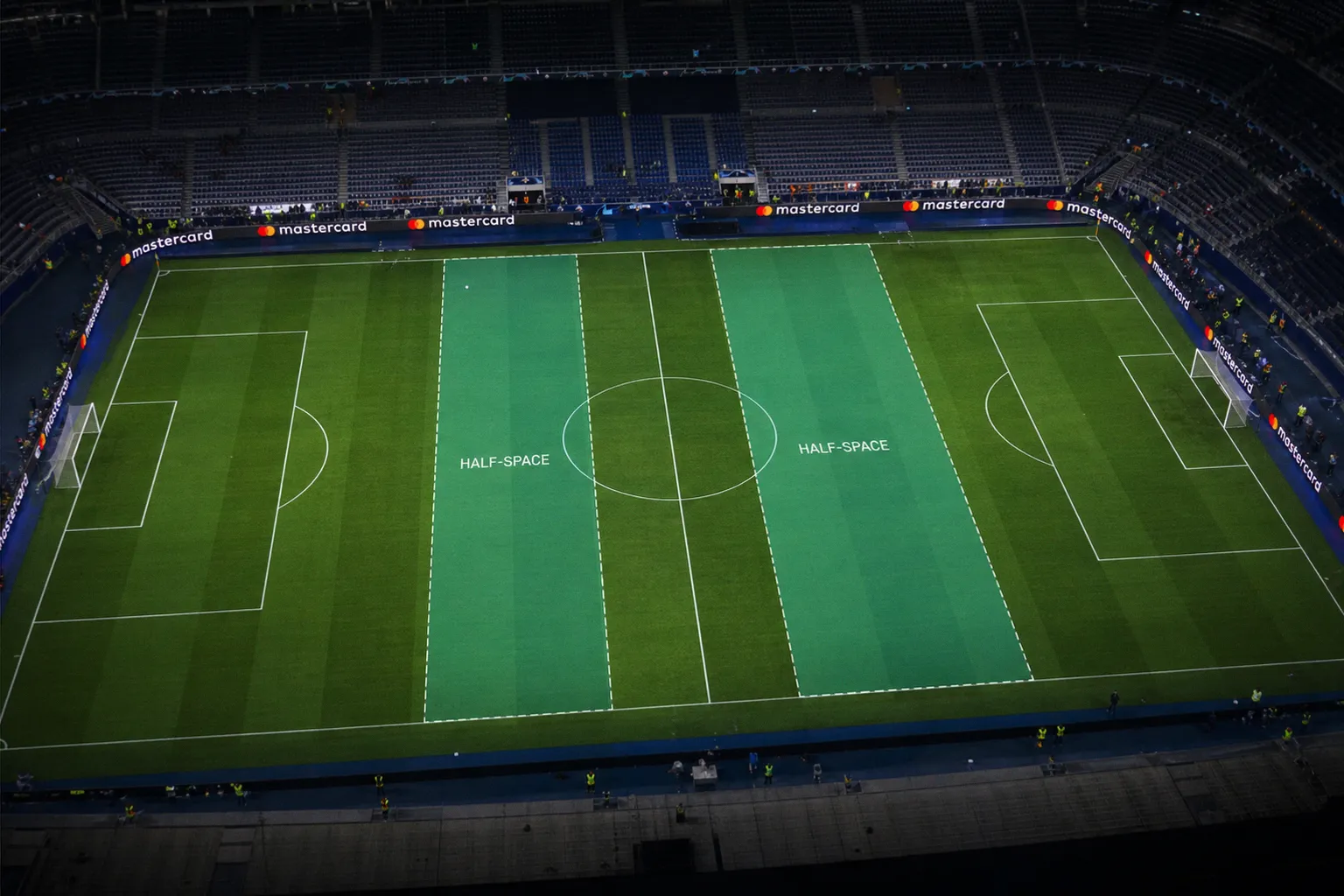
The geometry of the pitch: where the half-space actually lives
A standard pitch is rarely thought of in zones, but every modern analyst treats it as a five-channel grid: two wide corridors along the touchlines, two half-space corridors just inside them, and a central spine. The half-spaces sit roughly between the width of the penalty box and the central lane — the area where a central defender marking a runner must turn his body outward, where a holding midfielder must shift across to cover, and where a wide player arriving late can pick up a pass without breaking stride.
The reason this corridor matters more than the central spine is positional geometry. A central defender can read a through ball down the middle because the angle is straight and his body is already aligned. A full-back can read a cross from the touchline because the angle is wide and obvious. The half-space is the diagonal: it forces a defender to make a sideways decision while watching a runner who is neither in front of him nor clearly to one side. That decision is the entire ballgame.
This is also why traditional number-10s — the classic trequartista — have not disappeared from the game; they have been repositioned. Where a Zidane or a Rivaldo drifted from the central spine to find pockets, a modern equivalent drifts into the half-space to receive between the lines, with full-backs pushing underneath and a winger pinning the back four wide.
Disrupting the defensive block: the central defender's dilemma
When an attacking player receives the ball in the half-space, three things happen to the defending structure simultaneously. First, the nearest central defender must step out to engage — if he does not, the attacker can turn and shoot or play a cut-back onto the penalty spot with a high expected-goals return. Second, the defensive midfielder must either step across to provide cover or stay home, which exposes either the half-space to a second runner or the central lane to a vertical pass. Third, the full-back on that side must hold his width or tuck in, which either leaves the winger free or leaves the corridor behind the defensive line open.
That is three decisions, made in roughly two seconds, by three different players. The attacking side, in contrast, is making one decision: where to play the next pass. The asymmetry is the point.
This is also why the half-space is difficult to defend without sacrificing shape. A centre-back who steps into the half-space to engage a runner vacates the central zone. A defensive midfielder who shifts across to cover leaves a passing lane open between the lines. A full-back who tucks in concedes the touchline. Each defensive correction opens another problem. The attacking team, if it has runners timed correctly, can pick which problem to exploit. This is not a tactical quirk. It is arithmetic.
Creating overloads: how Guardiola and Klopp rewrote the playbook
Pep Guardiola's Manchester City and Jürgen Klopp's Liverpool did not invent half-space occupation — Italian football had been working the corridors for decades — but they industrialised it. Both managers built systems where the nominal winger (often a wide forward operating inside) and the attacking midfielder both positioned themselves in the same half-space, creating a numerical advantage against a back four that, by definition, cannot match up man-for-man without abandoning its shape.
When City or Liverpool pinned a full-back with their wide forward and stationed an inside forward in the half-space, the opponent's centre-back faced a choice: step out and leave the central zone exposed, or hold position and concede the cut-back. Either answer cost something. If the centre-back stepped, the striker peeled into the channel behind him. If the centre-back held, the cut-back arrived at the penalty spot, where the expected-goals value is among the highest on the pitch.
Overloads are not about having more players. They are about forcing the defending structure into a question it cannot answer without conceding something else.
Klopp's version differed in tempo and trigger. Liverpool's press was designed to win the ball back in advanced positions and attack the half-space immediately, before the defensive block could reorganise. Guardiola's version was slower, more positional, but the destination was the same: a controlled entry into the half-space with a runner timed to receive between the lines. The managers had different dialects. They were arguing the same thesis.
The financial implication, which the press rarely follows, is that both clubs spent heavily on players who could operate in those specific corridors — wide forwards comfortable receiving inside, midfielders comfortable arriving late, full-backs comfortable inverting. The transfer fees attached to those profiles reflect the half-space premium. A winger who can only hug the touchline is now a discount asset. A winger who can play half-space and full-back is the market's preferred currency.
Statistical efficiency: why half-space passes outperform wide crosses
The expected-goals data tells the same story the geometry suggests. Passes that originate from the half-space — particularly cut-backs and through-balls into the penalty area — convert into shot-quality chances at a meaningfully higher rate than crosses from the touchline. The reason is shot location and body shape. A cross from a wide position typically arrives at a stretched angle, with the receiving attacker often facing his own goal or competing with a defender arriving simultaneously. A pass from the half-space typically arrives at the penalty spot or the edge of the six-yard box, with the receiving attacker facing goal and the defender already displaced.
| Channel of entry | Typical receiving zone | Body shape of receiver | Relative xG conversion |
|---|---|---|---|
| Wide cross (touchline) | Edge of six-yard box or back post | Sideways or back to goal | Low |
| Half-space cut-back | Penalty spot / edge of six-yard box | Facing goal, side-on to defender | High |
| Central through-ball | One-on-one with goalkeeper | Facing goal, clear sightline | Highest (but rarest) |
| Half-space through-ball | Channel behind the defensive line | Running onto ball, facing goal | High |
The central through-ball produces the highest individual xG figure, but it is also the rarest and the hardest to manufacture, because the defending structure is densest in that lane. The half-space is the compromise: enough space to receive and turn, enough proximity to goal to make the next action dangerous, enough displacement of defenders to make the shot angle favourable.
This is not a coincidence. It is the reason clubs now recruit specifically for half-space profiles. A player who can receive between the lines, turn under pressure, and play the cut-back has a market valuation that reflects the conversion premium. A player who can only receive with his back to goal and lay it off is, structurally, a discount.
The market has priced what the xG model confirms: the half-space is the most efficient attacking zone, and clubs pay a premium for players who can operate there.
One caveat the data demands: the conversion premium is a tendency, not a guarantee. Half-space dominance does not insulate a team from poor finishing, individual errors, or a defensive block that refuses to engage. The arithmetic favours the attacker. The arithmetic does not play the game.
Counter-tactics: mid-blocks, narrow shapes, and the limits of the doctrine
Every tactical advantage eventually meets its counter, and the half-space doctrine is no exception. The two most common responses are the mid-block and the narrow defensive shape.
A mid-block — a defensive line set somewhere between the halfway line and the eighteen — denies the half-space by reducing the distance between the defensive and midfield lines. If those two lines are compact, there is no pocket between them for an attacker to receive in. The half-space still exists geometrically, but functionally it has been compressed into a space too tight to turn in. The trade-off is that a mid-block concedes sustained possession, which eventually tests the block laterally and vertically.
A narrow defensive shape — two banks of four set inside the width of the penalty box, full-backs tucked in, wide midfielders covering the touchline — achieves a similar effect by overcrowding the central and half-space channels. The attacker cannot find the corridor because the corridor is full. The trade-off is that the touchline is conceded, which brings the full-back and winger back into the game, particularly if the wide player can deliver against a packed box.
Both responses are reactive. Both require the defending side to absorb pressure for sustained periods. Neither eliminates the half-space; both compress it. The half-space doctrine has not been disproved. It has been made expensive to execute.
This is also why counter-attacking systems — the Simeone Atléticos, the early-phase Tuchel Chelseas — still hold a market. They do not compete for the half-space. They concede it and attack the space behind the press instead. The half-space is a positional doctrine, not a universal law. A team built to absorb and transition can win without ever controlling that corridor, provided it has the defensive structure to absorb and the runners to punish the transition.
What the boardroom understands that the terraces don't
The popular conversation about football tactics still orbits around signings, formations, and individual brilliance. The half-space conversation sits below that, in the operational layer where managers, analysts, and recruitment departments actually make decisions. It is why a club will pay a premium for a midfielder who can operate between the lines. It is why a coaching staff will drill cut-back patterns instead of crossing patterns. It is why a defensive coach will accept conceding the touchline in order to compress the corridor where the xG accumulates.
The half-space is not a fad. It is the geometry of the modern game made explicit. The pitch has not changed. The arithmetic has. The managers who understand that arithmetic win more often than the managers who argue about it in press conferences. The clubs that recruit for it spend more efficiently than the clubs that chase names. And the players who can operate in it are paid accordingly.
The next time a manager explains that his team is "trying to play through the middle," read the actual movement. The middle he means is rarely the central lane. It is the fifteen-to-twenty-metre corridor just inside it, where defenders must choose, where the xG accumulates, and where the transfer market has already priced the premium.