Sevilla football stadium tour: Evolution of the fan experience
The sevilla football stadium tour is not just a walk through concrete, seats and a trophy room. It is a controlled asset: a 60-to-90-minute conversion of club history into fan revenue, brand loyalty and repeat attention. Sevilla FC understands that.
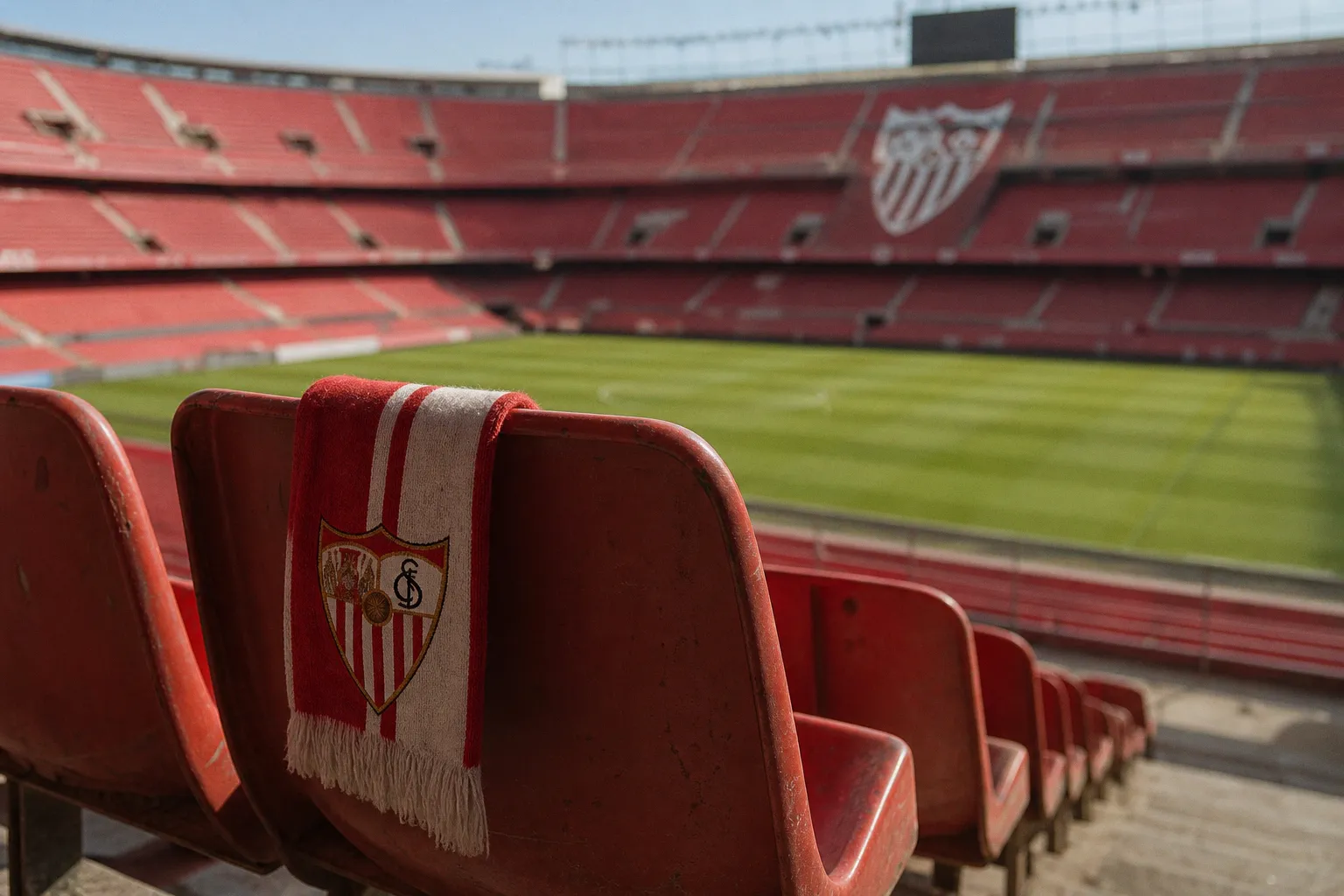
That story has a commercial spine. Opened in 1958, renovated significantly in 2015-2016, and now sold through timed digital ticketing, the stadium has moved from civic football venue to curated visitor economy. The club’s seven UEFA Europa League titles are not merely displayed. They are leveraged. In modern football, memory has a margin.
The Pizjuán is small enough to feel intimate, big enough to carry weight
The Ramón Sánchez-Pizjuán does not operate like the mega-stadiums that sell scale first and personality later. It has a different proposition. The building sits in that middle tier of European grounds where the matchday reputation can still feel sharper than the corporate package. A visitor does not need 80,000 seats to understand why the place matters. In fact, the tighter bowl helps the pitch-side portion of the ramon sanchez pizjuan stadium tour. You are close enough to feel the geometry of pressure.
The stadium opened in 1958, a period when European football architecture was still built around civic pride rather than global tourism. That distinction matters. Many modern stadium tours suffer from the same problem as modern transfer briefings: the language is polished, the product is expensive, and the soul has been amortized over too many departments. The Pizjuán avoids some of that because it has inherited texture. It was not designed first as a shopping funnel. It became one.
The 2015-2016 renovation changed the stadium’s face and function without erasing the core identity. The facade, seating and fan facilities were modernized, and that work now underpins the tour experience. Better circulation, cleaner presentation and more coherent visitor handling are not glamorous details, but they decide whether a stadium tour feels like a guided afterthought or a serious arm of club operations.
Follow the money and the logic is simple. A club of Sevilla’s profile cannot rely only on matchday attendance, broadcast distributions and player trading. It has to monetize loyalty across the calendar. Tours do that cleanly. They sell access when there is no match. They turn the stadium from a biweekly event venue into a daily brand site.
A stadium tour is the least sentimental product in football: it sells emotion by the time slot.
That is why the digital ticketing system matters more than it sounds. Allowing fans to book specific slots online is not just convenience. It manages crowd flow, protects the perceived value of the visit and gives the club cleaner data on demand. Clubs talk about “fan experience” in public. Privately, the useful phrase is yield management.
From 1958 structure to modern fan product
The evolution of the Pizjuán tour mirrors the wider shift in European football. Once, the stadium was the destination because the match was the product. Now the venue itself has to work between matches. The museum, the press room, the dressing room, the tunnel, the presidential box and pitch side each serve a different commercial and emotional function.
This is not accidental. The best stadium tours are built like a rights package. Each access point sells a different layer of proximity.
| Tour element | What the fan sees | What the club is really packaging |
|---|---|---|
| Sevillista Experience museum | Trophies, memorabilia, interactive displays | Institutional memory and global identity |
| Press room | Media backdrop, interview setting | Authority, visibility and the performance of control |
| Home dressing room | Player environment and matchday ritual | Proximity to labour assets without actual access to them |
| Tunnel | Transition from private space to public theatre | Anticipation and emotional escalation |
| Pitch side | Stadium scale and atmosphere without the match | The closest legal substitute for playing access |
| Presidential box | Executive viewpoint | Hierarchy, governance and elite status |
The presidential box is often misunderstood by fans as just another privileged seating area. It is more revealing than that. It shows how football is arranged. The public consumes from the stands, the players perform on the pitch, and the real leverage often sits above both. A well-designed tour lets supporters occupy that space briefly. It does not democratize power. It displays it.
The tunnel, by contrast, is the easiest sell. Every club knows it. Even the most skeptical visitor understands the pull of that short corridor. It is where football manufactures tension efficiently. The player leaves a controlled room, passes through a narrow channel, and enters an arena designed to turn noise into pressure. For Sevilla, whose European nights have been central to the club’s reputation, that part of the tour carries more weight than a generic photo opportunity.
The Sevillista Experience: history converted into an interface
The Sevillista Experience museum is the core of the visit. It features interactive displays, trophy collections and historical memorabilia, and it gives the club a controlled environment in which to explain itself. That control is valuable. Clubs dislike leaving their own history to broadcasters, rivals or social media edits. A museum lets them fix the sequence.
The headline asset is obvious: seven Europa League titles, as of 2024. For any club outside the small cartel of annual Champions League superpowers, that haul is not just sporting history. It is positioning. Sevilla’s modern European identity rests on being ruthless in a competition many richer clubs treat inconsistently until it becomes useful. The museum has every reason to make that record central.
There is a financial subtext here as well. European success changes a club’s commercial vocabulary. It supports sponsorship conversations, helps international fan acquisition and gives merchandise a story beyond local allegiance. When a visitor buys sevilla fc museum tickets, the club is not selling glass cases. It is selling proof of relevance.
The interactive layer is part of the same equation. Football museums that rely only on old shirts and dusty captions increasingly fail, especially with younger visitors who encounter clubs first through clips, games and fantasy football platforms rather than family inheritance. Sevilla’s move toward interactive presentation is not decorative. It recognizes that fandom has changed its entry points.
A supporter from Andalusia may arrive with inherited memory. A tourist on a seville football stadium visit may arrive with a cheap-flight itinerary, an interest in Spanish football and perhaps a vague awareness of Europa League dominance. The museum has to serve both without patronizing either.
That is where the tour’s balance matters. Too much nostalgia and the international visitor gets lost. Too much digital gloss and the local supporter sees a club laundering its past into screens. The more effective approach is layered: physical trophies, shirts and memorabilia for weight; interactive displays for navigation and engagement; spatial access to make the whole thing feel earned.
Behind the scenes, but not behind the business
The appeal of any stadium tour rests on a useful fiction: that the visitor is going behind the curtain. In reality, clubs are highly selective about which curtains move. Sevilla’s tour typically includes the press room, home dressing room, tunnel, pitch side and presidential box. It does not mean unrestricted access, and it should not. Training facilities and operational player spaces remain protected for good reason.
The home dressing room is the most carefully managed part of that equation. It gives fans proximity to the players’ working environment without interfering with the actual workplace. Modern clubs are extremely disciplined about this. The dressing room is now part tactical zone, part recovery area, part content backdrop and part psychological chamber. On a tour day, it becomes a set.
That does not make it fake. It makes it managed. Football is full of managed authenticity. The scarf held up at a signing. The badge-kissing photograph. The agent-fed denial before a release clause is activated. The stadium tour belongs to the same family, just with better lighting and fewer legal complications.
Pitch-side access has a different value. It recalibrates the stadium. From a television camera, every ground is flattened into a broadcast product. From the lower edge of the pitch, sightlines, distances and stand steepness become real. At the Pizjuán, that closeness helps explain why the ground has a reputation for heat. Not weather. Pressure.
The press room is less emotional but more instructive. It is where the club’s public language is produced: injury updates, managerial posturing, transfer evasions, crisis containment. Fans often treat the press room as a novelty backdrop. Executives understand it as a risk-control chamber. What is said there can move markets, alter leverage and reset expectations.
The most revealing room in a stadium is not always the dressing room. Sometimes it is where everyone pretends the negotiation is not happening.
A sevilla stadium tour review that focuses only on whether the seats are comfortable misses the point. The route shows the anatomy of a club. Not the whole anatomy, of course. No club sells that. But enough to understand how power, performance and memory are staged.
Digital ticketing changed the tour before the visitor even arrives
The modern fan journey begins before the stadium gates. Sevilla’s digital ticketing system for stadium tours allows visitors to book specific time slots online, which sounds like a routine operational improvement until you look at what it enables.
Timed entry gives the club control over density. It protects the experience from overcrowding, reduces bottlenecks in narrow points like tunnels and dressing-room access, and creates a more predictable staffing model. It also gives the visitor a cleaner expectation: arrive at a defined time, enter a defined route, consume a defined product.
That matters in a city with strong tourism flows and a football club with international recognition. The casual visitor is not always prepared to build a day around a stadium. A bookable slot lowers friction. For the club, that is a small but meaningful form of conversion optimization.
There is also a data question. Clubs increasingly want to know who their visitors are, when they come, how they buy, and what else they might purchase. A tour ticket is not just a ticket. It can be the first line in a customer profile: domestic fan, international tourist, family group, football obsessive, groundhopper, merchandise buyer. In a sport where clubs complain constantly about revenue gaps, ignoring that information would be negligent.
This is where fan culture and business meet without much romance. The supporter sees access. The club sees segmentation. Both can be true.
For fantasy football managers, groundhoppers and tactical tourists, the Pizjuán offers a different kind of value. It will not help pick a captaincy option or decode a pressing structure directly. But it sharpens context. Stadiums shape behaviour. Certain grounds generate urgency differently. Certain clubs build institutional memory around specific competitions. Sevilla’s Europa League identity is a case study in how a club can turn tournament success into culture, and then turn culture into a visitor proposition.
How to read the tour properly
The mistake is to treat the sevilla football stadium tour as a simple checklist: museum, dressing room, tunnel, pitch, box. That is the surface product. The better reading is to ask what each stop says about how Sevilla wants to be seen.
The club wants to be seen as historic but not frozen, European but not detached from place, ambitious but not delusional about its economic tier. That last point is crucial. Sevilla does not operate with the financial muscle of Spain’s two giants or the Premier League’s inflated middle class. Its brand has had to be built through recruitment cycles, European efficiency and the ability to sell success in concentrated form.
The tour reflects that. It does not need to pretend the Pizjuán is the Bernabéu. It should not try. Its value is different: intensity, European pedigree, a manageable scale and a museum narrative that has a clean hook. Seven Europa League trophies are easier to explain than a vague century of almosts.
For visitors planning the tour, a few practical distinctions matter more than generic advice:
1. Book a timed slot rather than treating entry as casual. The club uses digital ticketing to manage flow, and the tour works best when the route is not congested. A stadium loses atmosphere quickly when a visitor queue turns it into an airport corridor.
2. Allow the full 60 to 90 minutes. Rushing this kind of visit is poor value. The museum needs time because the European story is the commercial and historical centre of the offer. The pitch-side and tunnel sections then make more sense.
3. Treat the trophy display as the main argument, not a decoration. Sevilla’s Europa League record is the club’s strongest international calling card. Everything around it gains meaning from that competitive identity.
4. Do not expect access to private training operations. Stadium tours sell controlled proximity, not operational intrusion. The distinction is healthy. A serious club protects player spaces.
5. Use the presidential box as context. It is easy to photograph and move on. Better to read it as the governance layer of the stadium: where guests, executives and institutional relationships are staged.
None of this requires inflated language. The Pizjuán is not a theme park, and it is better for that. The tour’s strength is that it can carry both the local memory of a serious Andalusian club and the international shorthand of European success.
The fan experience after renovation
The 2015-2016 modernization is important because fan experience is usually won or lost in unromantic places. Seating, facade, circulation, facilities: these do not make folklore, but they affect whether a visitor believes the club is competent. Poor infrastructure weakens even the best museum narrative. It tells the customer the club is trading on sentiment while underinvesting in the product.
Sevilla’s upgrades helped move the Pizjuán into a more credible modern category without stripping its identity. That is a difficult balance. Football executives often talk about modernization as if every ground should become a neutral hospitality platform with a club crest attached. That logic is profitable in the short term and dangerous over time. If every stadium feels the same, only the richest brands win.
The Pizjuán’s advantage is specificity. The ground has a recognizable name, a defined capacity, a European story and a city context that does not need artificial drama. The tour’s job is to organize those assets, not smother them.
For fan culture, this is the broader lesson. Stadium tours have become part of how clubs compete for attention outside the match. Not every visitor will become a member, buy a shirt or return for a league fixture. But some will. Others will carry the club’s story into their own football networks. That secondary distribution is harder to measure but commercially useful. The modern supporter economy runs on memory, images and shareable proof of access.
Again, follow the money. A visitor enters through digital booking, moves through curated history, encounters trophy legitimacy, stands near the pitch, photographs controlled spaces and exits with a stronger sense of the club. Somewhere along that route, there is likely a retail opportunity. This is not cynical as an accusation. It is simply how football works now.
The likely direction: more immersion, tighter control
The next evolution of the Sevilla tour is unlikely to be about raw access. Clubs are not going to open more sensitive sporting areas just because tourists want them. The more probable direction is deeper digital integration: more interactive museum content, richer archival presentation, possibly expanded virtual reality elements, and cleaner links between ticketing, retail and membership databases.
That is the boardroom outcome because it offers upside without compromising operations. More immersion can be sold. More access can become a liability. There is a difference.
The Ramón Sánchez-Pizjuán does not need a major structural reinvention to make its tour more valuable. Its current opportunity sits in refinement: better storytelling, sharper multilingual content, smoother visitor flow, and continued use of the Europa League legacy as the central asset. Maintenance and fan experience optimization are more plausible than grand expansion rhetoric.
For the supporter, that may sound less exciting than a promise of new stands or unrestricted dressing-room access. For the club, it is the sensible play. Sevilla’s stadium tour works because it is built around a credible identity, not fantasy. It sells the Pizjuán as it should: compact, intense, decorated and commercially awake.
The final read is straightforward. The sevilla football stadium tour is not merely a tourist stop in Seville. It is Sevilla FC’s boardroom-approved version of itself: history arranged for consumption, European success placed under glass, and access rationed just enough to feel valuable. In modern football, that is not a side business. It is part of the model.