Best Football Formations: Key Strengths of the Top Systems
In a 4-4-2, 60% of the players cover 60% of the pitch. Arsène Wenger put that arithmetic on record in 2009 as the case for what he called the most rational formation in football.
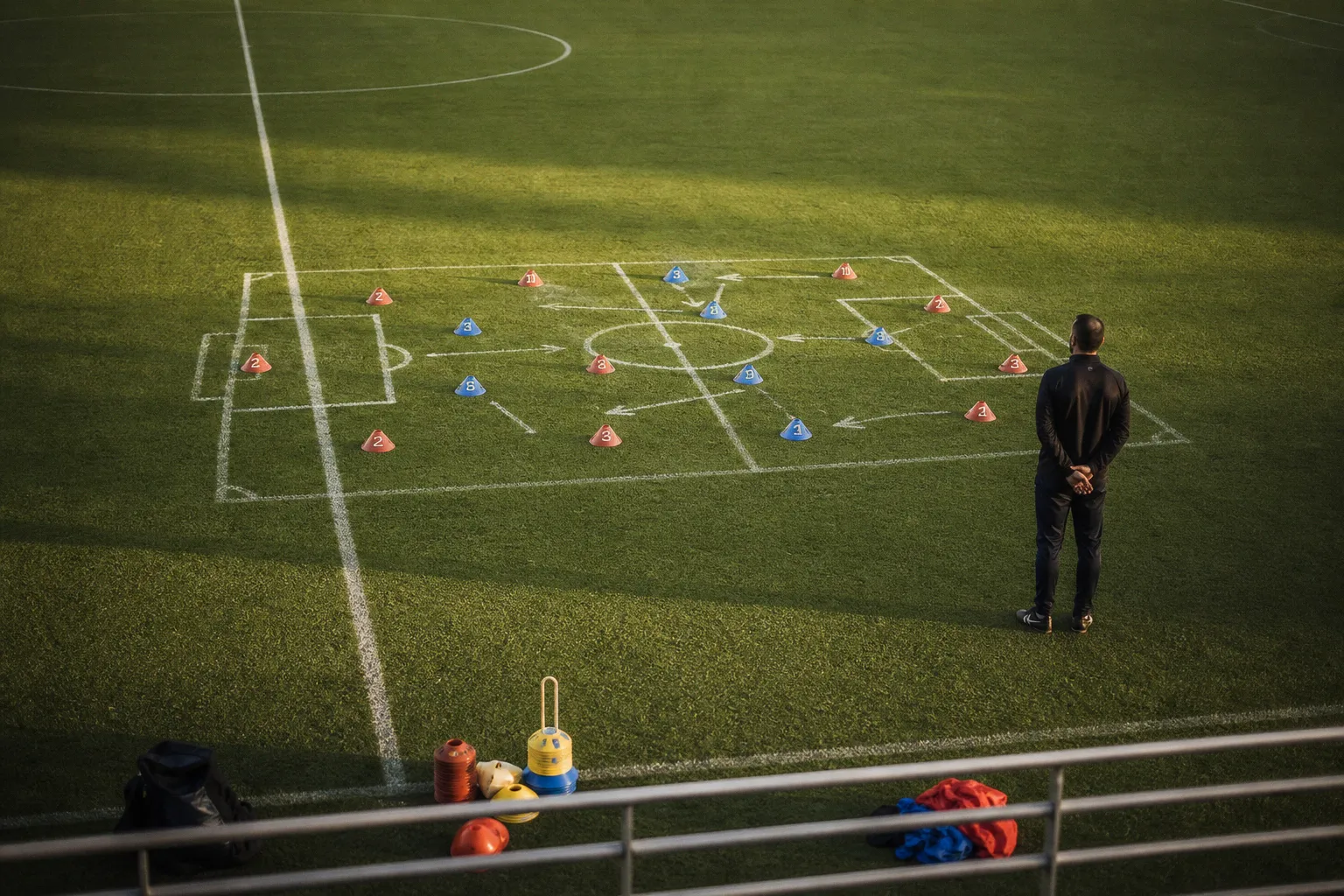
The principle — maximum spatial coverage with minimum structural complexity — still anchors every serious tactical conversation about the best football formations. Three systems now sit above that baseline in elite-level usage: the 4-3-3, the 4-2-3-1, and the 3-5-2. A fourth, the 3-2-4-1, has emerged less as a starting shape than as an in-possession transition state for the most possession-dominant clubs in Europe.
Spatial efficiency is the starting point, not the finishing point. The 4-4-2 owns the cleanest coverage geometry in football; every modern system is a partial answer to its structural weaknesses.
The 4-4-2 and the Geometry of Spatial Coverage
Wenger's argument was geometric, not romantic. A 4-4-2 places eight outfield players across two parallel banks of four, occupying the central and wide lanes simultaneously. The shape lets the defensive block shift laterally as a unit, compresses the central corridor to one-versus-one duels, and leaves the two strikers as the first line of pressure against the opposition centre-backs.
That geometry is the structural reason the 4-4-2 produced consistent results against possession-heavy opponents with a fraction of the ball. It is also the reason the formation has largely disappeared from elite-level use: against a three-man midfield, the two central midfielders of a 4-4-2 are outnumbered in second-ball situations; against a back three that drags the wingers inside, the full-backs are exposed in the half-spaces.
The 4-4-2 persists where the striker profile justifies it — typically a target nine paired with a channel-running second striker — and at clubs with a defensive identity built around compactness rather than territorial pressure. At elite level, it has been replaced by structures that preserve the 60%/60% spatial principle while restoring central-midfield numerical superiority.
Passing Triangles and High-Pressing in the 4-3-3
The 4-3-3 is the most common starting shape among pressing-oriented sides in the top-five European leagues. Its structural advantage over the 4-4-2 is the three-man forward line, which produces passing triangles with the two deeper midfielders and a vertical reference point in the nine.
In possession, the 4-3-3 builds through two distinct triangles. The first forms between the left-back, the left-sided central midfielder, and the left winger inverted onto the half-space. The second mirrors the structure on the right. Against a 4-4-2 defensive block, these two triangles create numerical superiority in the build-up: the defending side commits eight outfield players behind the ball, while the 4-3-3 commits eight to the first two lines, with the nine retained as the vertical outlet.
The 4-3-3 is a high-press system by design. Three forwards trigger the opposition build-up, the eights cut the central passing lanes, a single pivot screens the back four behind them.
Out of possession, the 4-3-3 typically shifts to a 4-1-4-1. The single pivot screens the centre-backs, the two eights press the opposing double pivot, and the front three triggers the press against the centre-backs and the single pivot of the opposition. A well-coordinated 4-3-3 can apply pressure at a PPDA below 10 against a passive build-up; top pressing sides operate in that range for extended sequences.
The vulnerability sits in the relationship between the wingers and the full-backs. When the winger tucks inside to form the half-space triangle, the opposite-side full-back has time and space on the touchline. When the winger stays wide, the triangle collapses and the build-up reverts to a sideways passing pattern. Pressing sides manage this by instructing the full-backs to push higher; possession sides manage it by inverting the full-backs into the half-spaces instead.
The Double Pivot: Defensive Security in the 4-2-3-1
The 4-2-3-1 is the most common framework among counter-attacking sides. The structural anchor is the double pivot — two defensive midfielders positioned directly in front of the back four. The system exists to neutralise counter-attacks before they reach the centre-backs.
The defensive logic is arithmetic. A counter-attack that beats the first line of pressure still meets a second. With two pivots, the second line defends two-versus-two against the two most advanced midfielders of the opposition. Against a 4-3-3, this means the double pivot can shadow both eights and force the nine to receive with back to goal, isolated from supporting runs.
Out of possession, the 4-2-3-1 typically converts to a 4-4-1-1 or a flat 4-4-2. The ten drops to form a second striker line alongside the nine, while the wide midfielders track the opposition full-backs. The system is therefore two structures in one: a defensive shape that compresses the central corridor and an attacking shape that exploits the half-spaces through the ten and the two wide midfielders.
The trade-off is creative output. Two defensive midfielders reduce the number of line-breaking passing options in the build-up, which is why most 4-2-3-1 sides concentrate their expected threat per ninety around the ten. Remove the ten from the structure and the system reverts to a sideways passing pattern against a settled low block. Atlético Madrid under Simeone, Leicester City in 2015–16, and several national-team setups have accepted that trade-off as the price of defensive security.
Wing-Back Dynamics and Overloads in the 3-5-2
The 3-5-2 asks a specific structural question: what is the cost of width when the central corridor is the priority? The cost is concentrated on the wing-backs, who carry the highest positional load in the formation. They typically cover the longest average distance per game, providing width in possession and dropping into a back five out of it. Few roles outside the goalkeeper demand more from the athletes involved.
The build-up advantage is significant and mathematically clean. A back three plus the goalkeeper creates a four-player first line. Against the typical two-forward front line, that produces a 4v2 superiority; against a single-striker system, it produces a 4v1. In both cases the centre-backs can step forward with the ball without being immediately pressed, the wide centre-backs split toward the touchlines, and the wing-backs push high to occupy the wide lanes. Inside that structure, the single pivot or pivot pair has multiple progression options and access to the half-spaces.
The 3-5-2 also maps cleanly onto the 3-2-4-1 in possession. One of the centre-backs pushes into the midfield line, the wing-backs advance to the wide channels of the attacking third, and the front two split into the half-spaces. Out of possession, the shape recovers into a five-man defensive line with the wing-backs tracking the wide players of the opposition.
The risk is concentrated in the half-space between the wing-back and the central centre-back. A winger who inverts onto that lane and receives between the lines finds a passing angle directly into the centre-forward. This is the structural reason several top-five-league sides switch from a 4-3-3 to a 3-4-2-1 specifically to occupy the half-space against a 3-5-2.
Structural comparison of the three core starting systems
| Parameter | 4-3-3 | 4-2-3-1 | 3-5-2 |
|---|---|---|---|
| Defensive base shape | 4-1-4-1 | 4-4-1-1 / 4-4-2 | 5-3-2 / 5-4-1 |
| Build-up structure | Two half-space triangles via FB + 8 + inverted winger | Double pivot screens, ten as line-breaker | 4-man first line (GK + 3 CBs) creates 4v2 vs two forwards, 4v1 vs one striker |
| Pressing trigger | Front three vs CBs + single pivot | Two eights vs opposition pivots | Two strikers + near wing-back vs CBs |
| In-possession width | Wide forwards + overlapping full-backs | Wide midfielders + occasional FB overlap | Wing-backs carry both wide lanes |
| Midfield numerical superiority vs 4-4-2 | 3v2 | 2v2 (with screen behind) | 3v2 |
| Primary vulnerability | Half-space if winger inverts and FB holds | Creativity drop if ten is isolated | Half-space between wing-back and central CB |
| Typical elite usage | Klopp-era Liverpool, Manchester City base, Barcelona | Simeone's Atlético, Germany 2014–2016 | Inter under Inzaghi, Gasperini's Atalanta, Conte-era Chelsea |
Modern Evolution: The 3-2-4-1 as an In-Possession Transition
The 3-2-4-1 is rarely listed as a starting formation. The most accurate description is that it is an in-possession transition state, used by managers including Pep Guardiola and Marcelo Bielsa, applied from a base of 4-3-3 or 4-2-3-1. Treating it as a static shape understates the role positional rotations play in producing it.
The transition is structural rather than improvised. A centre-back pushes into the midfield line, pairing with the single pivot or replacing him to form a double pivot in front of the defence. The two full-backs invert into the half-spaces and push into the second line as attacking midfielders. The wide forwards tuck inside to form the inside channels alongside the nine.
The result in the final third is a 3-2-5: a back three as the first line of build-up, a double pivot as the vertical progression layer, and a front five occupying the width and the half-spaces simultaneously. Against a 4-4-2 defensive block, the front five produces a 5v4 in the attacking line. Against a 5-3-2, the central corridor remains accessible through the two inside forwards. This is the core of Guardiola's positional model — numerical superiority created not by adding players but by repositioning existing ones.
Out of possession, the shape recovers into either a 4-3-3 or a 4-2-3-1, depending on the starting structure. The full-backs track back to their original full-back positions on the touchlines, the centre-back who stepped into midfield drops back into the back four, and the wide forwards track the opposition wide players. The reversal is driven by the same positional rotations that produced the 3-2-4-1 in the first place, which is why analysts describe it as a state rather than a formation — the same eleven players cycle through different shapes within a single passage of play.
The 3-2-4-1 is not a formation. It is a positional state — the in-possession expression of a back four, and the most accurate description of how modern pressing sides attack a low block.
Trajectory of the Modern Tactical Landscape
The 4-3-3 retains its place as the most common starting shape among pressing-oriented top-five-league sides. The 4-2-3-1 remains the default counter-attacking framework at clubs that prioritise defensive security over territorial dominance. The 3-5-2 persists in systems built around central overloads rather than wide play — Antonio Conte's Chelsea, Inter under Simone Inzaghi, and Atalanta under Gian Piero Gasperini sit in this lineage.
The 3-2-4-1 is the direction the elite-level game is moving in. It is the in-possession shape of Manchester City under Guardiola, of the Argentina national team during the 2022 World Cup, and of several of the recent Champions League winners. It is not a separate formation; it is the modern expression of the 4-3-3 and the 4-2-3-1 once positional rotations are layered on top.
Selecting among these systems is therefore not a question of which formation is best in the abstract. It is a question of which structure aligns with the player profiles available, the pressing triggers that the opposition build-up will provoke, and the transitions between states that the squad can execute under pressure. The strongest teams cycle between all four of these shapes within a single match. A side that opens in a 4-3-3 may move into a 3-2-4-1 to break a low block, drop into a 4-4-1-1 to protect a one-goal lead, and recover to a 4-3-3 to re-press the back line.
That flexibility is the structural baseline of the modern game. The competitive edge at the top of the European club game now sits in the speed and precision of the transitions between these states, not in the static choice of which formation to write on the team sheet.