Evolution of the 3-5-2: From Conte to Modern Tactics
In the 68th minute in Istanbul, when Rodri arrived on the edge of Inter’s box and shaped the Champions League final, the most revealing detail was not simply Manchester City’s finish.
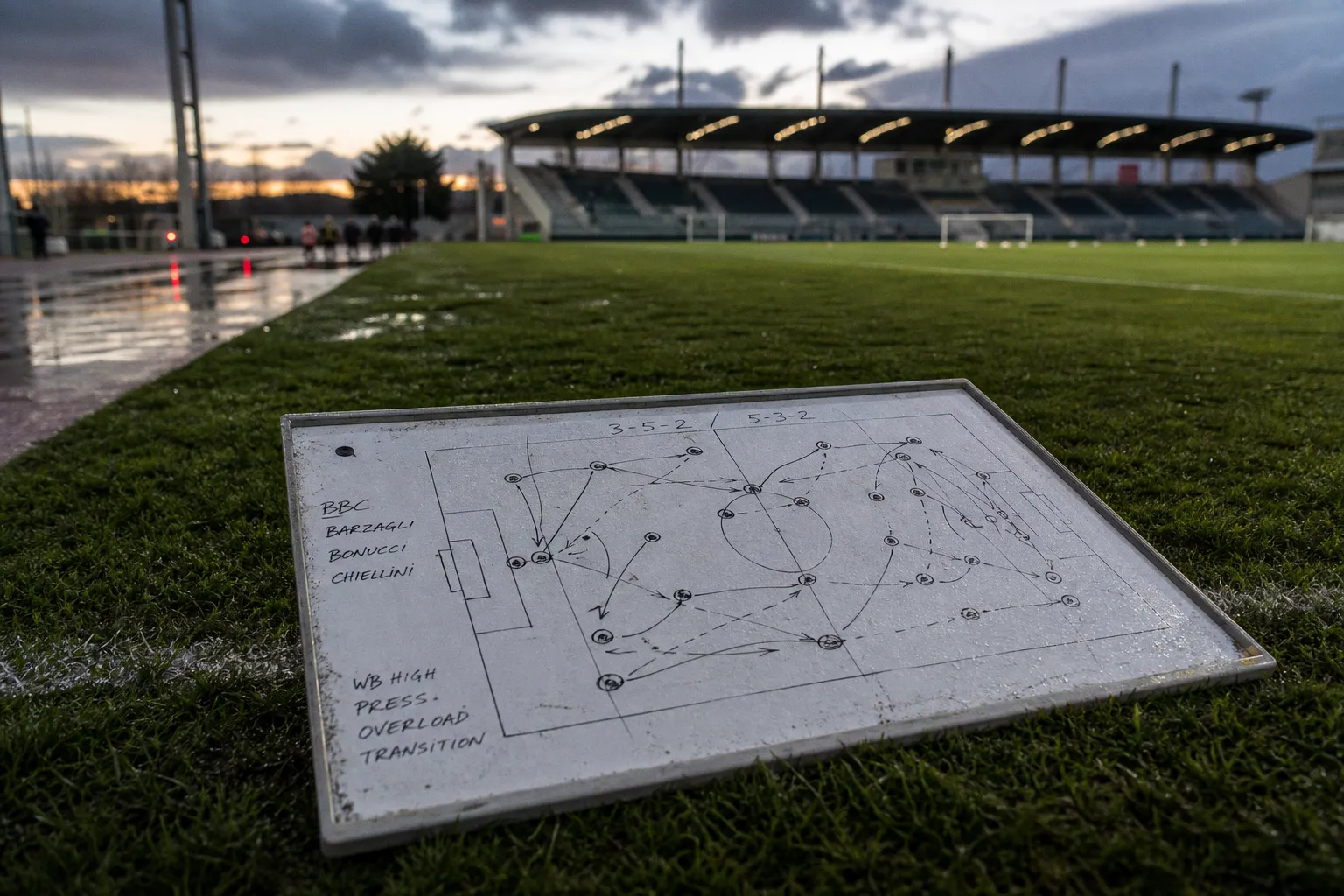
That night clarified where the debate around football formations 3 5 2 had moved. The system was no longer shorthand for caution, nor a nostalgic Italian shelter against superior attacking talent. In its modern form, it has become a structure of transition: three centre-backs to secure the first pass, three midfielders to contest hierarchy in the middle, two wing-backs to stretch the pitch, and two forwards to keep the opponent’s centre-backs from stepping into comfort. The shape is old. The stresses it now creates are not.
The Conte Blueprint: Stability Was the Start, Not the Whole Point
Antonio Conte’s Juventus from 2011 to 2014 remains the modern reference point because it gave the 3-5-2 a clean competitive logic. The “BBC” defensive trio — Andrea Barzagli, Leonardo Bonucci and Giorgio Chiellini — was not merely a protective wall. It was the mechanism that allowed Juventus to attack with conviction. Bonucci could pass through the first line, Chiellini could defend wide spaces with aggression, Barzagli could cover and reset the structure. The back three created a platform from which the rest of the team could act earlier and higher.
That distinction matters. Many readings of the formation still begin with the five-man defensive line, but Conte’s Juventus began with the advantage of having one more central defender than most opponents had forwards. Against a front two, the 3v2 gave one centre-back the licence to step into midfield. Against a single striker, it allowed the outside centre-backs to advance into half-spaces and pin the opposition wingers deeper than they wanted to be.
The consequence was territorial. Juventus did not need to win every duel in midfield if their back line could keep feeding the next phase. The wing-backs pushed high enough to create wide overloads, the central midfielders compressed second balls, and the two strikers gave the side a direct option when possession needed to become pressure.
Conte’s 2016 title-winning Chelsea side used more of a 3-4-3/3-5-2 hybrid, but the principle travelled intact: the extra defender was not an apology; it was insurance for more aggressive occupation elsewhere. The wing-backs became the emotional temperature of the system. If they played high, the formation looked expansive. If they were pinned back, it became a survival shape. The same numbers, different match.
The 3-5-2 is not defensive by birth. It becomes defensive when its wing-backs lose the touchline and its midfield stops stepping forward.
Conte’s legacy, then, is often mislabelled. He did not simply revive a back three. He reintroduced the idea that defensive stability could be the condition for attacking momentum rather than its opposite.
Numerical Superiority: Why the Extra Centre-Back Changes the Midfield
The first tactical advantage in a modern 3-5-2 is visible before the ball reaches the final third. With three central defenders, the team has a spare player against most two-striker systems. That spare man can stay as cover, but the best sides use him more ambitiously: he becomes a ball-playing pivot, stepping into midfield to alter the opponent’s pressing angles.
This is where the system’s appeal has widened beyond coaches who want a low block. A 4-3-3 can dominate the centre with three midfielders, but it often asks full-backs to manage width and progression at once. A 3-5-2 separates those jobs more clearly. The wing-backs hold the width. The three midfielders can stay connected. One centre-back can carry or pass into the next line. If the opponent presses with two forwards, the spare defender is the escape route. If the opponent presses with three, the goalkeeper and far-side centre-back become part of the circulation.
A simplified comparison shows why the formation remains attractive to managers who want control without losing vertical threat:
| Tactical question | 3-5-2 answer | Common risk |
|---|---|---|
| How does the team build against two forwards? | Back three creates a 3v2 and frees one defender to step in | Slow circulation if the spare player is not brave on the ball |
| Who provides attacking width? | Wing-backs, often positioned high and early | Vulnerable space behind them if possession is lost |
| How is midfield protected? | Three central midfielders can screen, press and support second balls | Can become flat if the No 8s do not break lines |
| How are centre-backs occupied? | Two strikers pin or split the defensive pair | Attack can become predictable if both forwards stay too high |
| How does the shape defend late pressure? | Drops naturally into a 5-3-2 | The team may lose counter-attacking distance if the block is too deep |
The strongest 3-5-2 sides are not those that merely place three midfielders on the team sheet. They are those that understand the distances between them. One midfielder anchors the centre, one offers the receiving angle, one presses forward or runs beyond. If all three stand in a line, the formation becomes easy to screen. If the staggering is right, the opponent must decide whether to close the centre-back stepping in, jump to the pivot, or hold shape and concede territory.
That is the small hierarchy on which the system depends. The back three gives you an extra player. It does not guarantee that the extra player will matter.
Wing-Backs: The System’s Width, Press and Vulnerability
No role exposes the modern 3-5-2 more honestly than the wing-back. It is the position where the chalkboard theory meets physical attrition. The player must start high enough to stretch the opposition full-back, recover deep enough to form a back five, press aggressively when the ball travels wide, and still have the legs to arrive at the far post when the attack develops on the opposite side.
In Conte’s Juventus, the wing-backs were central to creating overloads in wide areas. The same principle has survived, but the execution has become more varied. Some teams use one wing-back high and one conservative, creating a lopsided back four in possession. Others push both high and ask the outside centre-backs to defend large channels. The choice often reveals the manager’s appetite for risk more clearly than the formation label itself.
A modern 3-5-2 wing-back has four recurring jobs:
1. Pin the opposition wide defender. If the wing-back starts too deep, the opponent’s full-back can narrow into midfield and crowd the central three. High positioning stretches the pitch and opens the half-space for the No 8 or striker dropping off.
2. Trigger the press on backward or square passes. The touchline becomes a pressing tool. When the opponent plays into the full-back with a poor body shape, the wing-back can jump, the nearest midfielder can lock the inside pass, and the outside centre-back can prepare to cover the channel.
3. Attack the far post. In a 3-5-2, many dangerous chances are not created by classic winger dribbles but by switches and second-phase deliveries. The far-side wing-back often becomes the free runner because the opponent’s back line is occupied by two strikers.
4. Recover into the fifth defensive line. This is the unglamorous part. When the press is beaten, the wing-back must restore the 5-3-2 quickly enough to stop the opponent’s winger isolating the outside centre-back.
This is why recruitment matters so sharply. A coach cannot hide a passive wing-back in a 3-5-2. In a back four, a full-back can sometimes survive by defending his zone and passing inside. In this shape, the wing-back is a winger, full-back, pressing trigger and transition runner, often within the same passage of play.
The system’s weakness is therefore not mysterious. The space behind the wing-back is always the first question opponents ask. The answer depends on timing: the outside centre-back must shift early, the nearest midfielder must delay the counter, and the far-side centre-backs must narrow without abandoning the second striker. One late reaction turns a high press into a recovery sprint.
The Inzaghi Adjustment: Two Strikers, One Pocket, Constant Transition
Simone Inzaghi’s Inter have become the most persuasive recent example of the 3-5-2 as a fluid attacking system. Their run to the 2023 Champions League final did not rest on a static front two waiting for crosses. It relied on the movement of the strikers as a split pair: one forward occupying the centre-backs, the other dropping into the No 10 pocket to connect transitions.
That movement changes the geometry. When one striker drops, the opponent’s centre-back has a decision to make. Follow him and leave space behind; hold the line and allow him to turn; pass him to midfield and risk opening a lane for a third-man run. This is where the modern 3-5-2 becomes more complex than its notation. On paper, it has two forwards. In practice, it can look like a 3-5-1-1, a 3-4-2-1, or even a narrow 3-2-5 in settled possession.
Inter have often used this to accelerate attacks without becoming reckless. The dropping striker provides the wall pass. The wing-back advances. The near-side midfielder runs beyond. The second striker stays high, forcing the defensive line to retreat rather than compress. It is a chain of small obligations imposed on the opponent.
There is a useful way to think about the evolution of the 3-5-2 here. It is less a fixed drawing than a repeated pattern with controlled variation, not unlike how a sequence in visual work can shift meaning through small changes — the same logic that makes Damien Hirst and Saturday’s work series focus a study in repetition rather than duplication. In football terms, the notation remains stable, but the roles alter the picture.
The dropping striker is also essential defensively. When the ball is lost, he is often the first player able to block the opponent’s pivot. That single action buys time for the midfield three to compress and for the wing-backs to recover. Without it, the 3-5-2 can split into two disconnected units: five behind the ball and five ahead of it, with the centre of the pitch open for the opponent’s first clean pass.
The modern 3-5-2 lives in the moment after possession changes. If the first counter-press fails, the whole structure is suddenly facing its own ambition.
This is why the front two cannot be judged only by goals. Their pressing angles, ability to receive under contact, and willingness to alternate depth often define whether the system feels fluid or blunt.
From 3-5-2 to 5-3-2: The Low Block Is a Phase, Not an Identity
The defensive transition into a 5-3-2 is one of the formation’s cleanest strengths. When the wing-backs drop, the team can form a compact line of five, with three midfielders screening central access and two strikers positioned to discourage easy passes into the opposition pivot. Against teams built around wingers, this can be particularly effective. The wide attacker receives the ball, looks up, and sees both an outside centre-back and a wing-back controlling the lane.
That is the theory. The reality depends on compactness. A 5-3-2 block is strong when the back five and midfield three move as one unit. If the midfield line drops too close to the defenders, the opponent can circulate freely outside the box. If it stays too high without pressure on the ball, the space between the lines becomes available. The best sides manage this accordion effect with discipline: step out when the pass is slow, drop when the ball-carrier has time, and keep the strikers close enough to threaten the first outlet.
The formation is especially useful when protecting a lead because it does not require a full reshuffle. The same players can alter height and risk. A wing-back who spent an hour pinning the opposition full-back can spend the final 20 minutes blocking the crossing lane. A midfielder who had license to join attacks can sit beside the pivot. One striker can drop closer to midfield, leaving the other as the counter-attacking reference.
But this is also where matches can tilt. If the 5-3-2 becomes too passive, it invites volume: crosses, second balls, deflections, corners, and the slow attrition that turns territorial pressure into late chances. The formation can neutralize wingers, but it cannot abolish pressure. A team still needs a route out.
The best defensive 3-5-2 sides preserve at least one of three exits:
- A forward who can hold the first clearance. Without that, every clearance becomes another attack.
- A wing-back who can carry the ball 30 metres. This turns recovery into territory and forces the opponent’s counter-press to retreat.
- A midfielder who can receive facing his own goal and still find the next pass. This is the difference between defending and only delaying.
The low block, then, is not proof that the 3-5-2 is inherently conservative. It is proof that the system has a defensive landing point when the match state demands it. The problem comes when that landing point becomes the entire flight plan.
Strengths and Weaknesses: Why the Same Shape Produces Different Football
The phrase “modern 3-5-2 system” can conceal more than it explains. A counter-attacking 3-5-2 and a possession-based 3-5-2 may share the same numbers, but they ask different questions of the opponent. One waits for the opponent’s full-backs to advance and then releases two forwards into space. The other uses the back three and midfield triangle to build patiently, pushing wing-backs high and forcing the opponent into a back five of their own.
That is why broad claims about the 3-5-2 being “defensive” or “attacking” tend to collapse under match evidence. The system’s nature is set by behaviour, not notation.
Its clearest strengths are structural:
- Central security. Three midfielders and three centre-backs give the team numbers around the most valuable zone of the pitch.
- Flexible pressing. The front two can split toward centre-backs, screen the pivot, or angle pressure into wide traps.
- Natural rest defence. With three centre-backs behind the ball, the team can attack with wing-backs without leaving only two defenders exposed.
- Two-forward threat. Centre-backs are less free to step into midfield when they must track two attackers and manage runs across both shoulders.
- Late-game adaptability. The shift into 5-3-2 is simple and often does not require a substitution.
Its weaknesses are just as clear when the execution drops:
- Dependence on wing-back stamina and timing. If they are pinned deep, the team can lose width in attack and become narrow.
- Risk in the channels. Aggressive wing-back positioning leaves outside centre-backs defending wide spaces.
- Potential midfield flatness. Three central players do not guarantee progression if none can receive between lines.
- Predictable crossing patterns. Poor versions of the system drift into early wide deliveries without enough penalty-box occupation.
- Vulnerability to switches. If the block shifts too slowly, the far-side wing-back can be isolated before support arrives.
The most important line is the one between the wing-back and outside centre-back. That relationship determines whether the team can press high without fear. If the wing-back jumps and the centre-back follows too slowly, the opponent escapes down the side. If the centre-back jumps and the midfield fails to cover inside, the half-space opens. The system is strong because its distances are connected; it fails for the same reason.
Why Managers Keep Returning to It
The endurance of the 3-5-2 is not sentimental. Managers return to it because it solves several modern problems at once. It protects central defenders who may not want to defend huge spaces in a back four. It gives technically strong centre-backs more passing angles. It offers two strikers without surrendering midfield presence. It lets a team press high, then retreat into a stable low block without changing its entire identity.
That flexibility is valuable in leagues where match states change quickly and where opponents are increasingly trained to exploit rigid structures. The 3-5-2 can become a 3-1-4-2 in possession, a 5-3-2 without the ball, a 3-4-1-2 when a striker drops, or a 5-2-1-2 when protecting the centre late. The notation is only the starting point.
Conte gave the modern version its competitive authority. Inzaghi has shown how much fluidity can be built into it. Others will keep adapting it because the formation sits at an important tactical junction: secure enough to survive pressure, aggressive enough to create overloads, and elastic enough to change with the match.
The next stage will depend less on whether managers choose three centre-backs and more on what they ask the spare player to do. If he steps into midfield, the 3-5-2 can dominate the first phase. If the wing-backs hold their nerve, it can stretch elite opponents. If one striker connects play while the other threatens depth, it can turn transition into a sustained source of control.
The shape has travelled a long way from its reputation as a defensive refuge. Its modern value lies in the tension it manages: security against risk, width against compactness, control against verticality. That is why the evolution of the 3-5-2 remains central to tactical analysis. It is not a relic returning every few years under a different name. It is one of the game’s most adaptable answers to the current age of pressing, transition and positional detail.