Mestalla Stadium Tour: Why Valencia's Historic Ground Matters
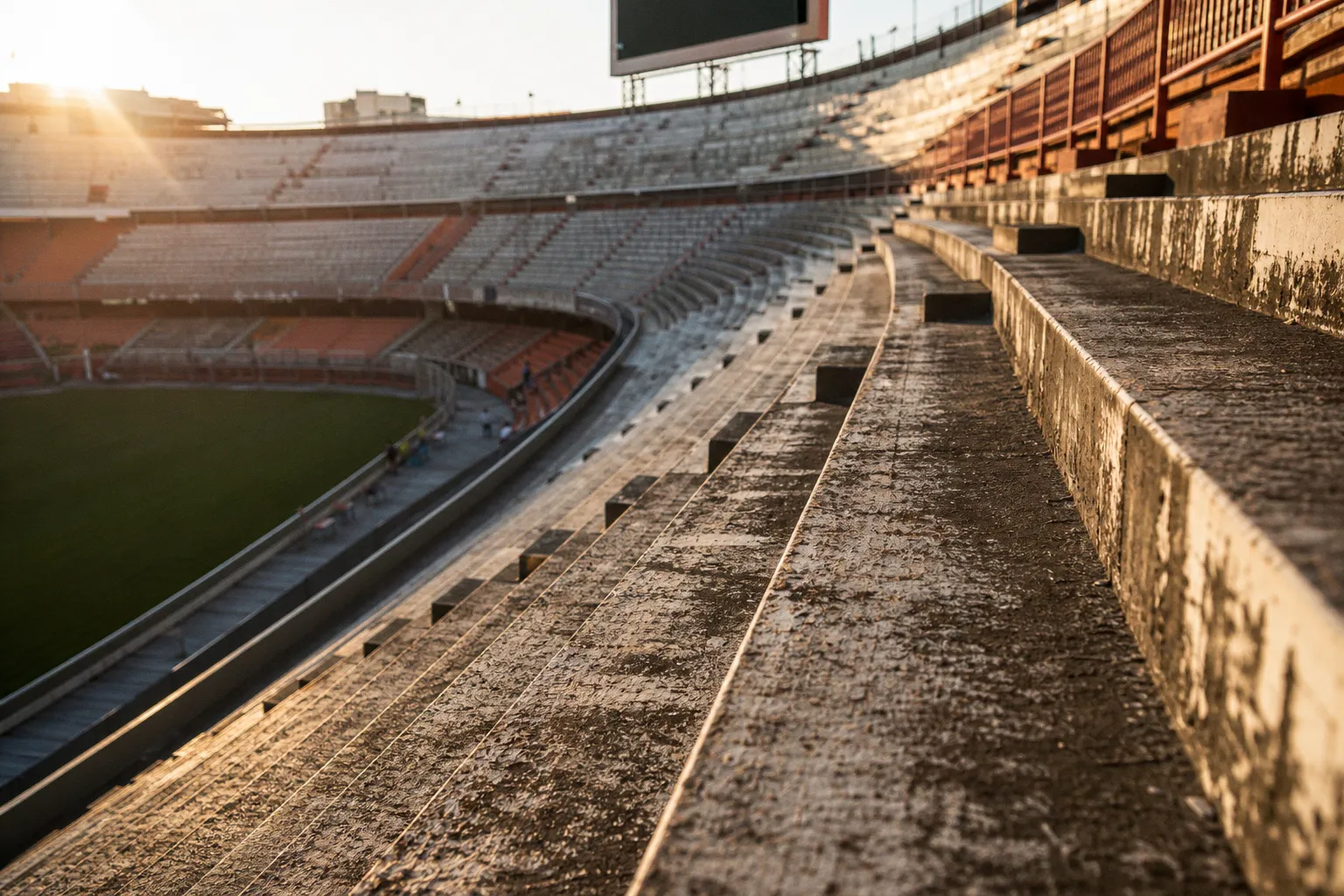
Mestalla holds 49,430 seats, yet its defining feature is not capacity. It is compression. The stands rise steeply from the touchline, reducing the visual and acoustic distance between crowd and pitch.
Mestalla Stadium Tour: Why Valencia's Historic Ground Matters
For a Valencia football stadium tour, that geometry is the central fact: this is a venue built for proximity, not spectacle at scale.
Opened on 20 May 1923 with a friendly between Valencia CF and Levante UD, Mestalla began with a capacity of 17,000. It became La Liga's oldest active stadium in January 2020. Valencia are now scheduled to leave for Nou Mestalla in the 2027–28 season, subject to the completion of the new ground. That gives the current tour a different function. It is no longer simply a behind-the-scenes product. It is access to a stadium approaching the final phase of its operational life.
A century of football shaped by constrained space
Mestalla is not a preserved monument in the static sense. Its structure has been altered repeatedly, but the core spatial relationship remains intact: a narrow visual corridor from stand to grass, with minimal empty volume around the playing surface.
Modern stadium design frequently prioritises circulation, hospitality areas and broad concourses. Mestalla was developed under a different set of constraints. The result is a ground where spectators appear stacked vertically rather than dispersed laterally. From pitch level, the stand faces create a near-continuous wall. From the upper tiers, the angle produces an unusually direct view of the penalty areas and half-spaces.
That matters tactically as well as culturally. Valencia's home matches are played inside a compact visual field. The crowd can track pressing triggers, turnovers and transitions without the distance imposed by an athletics track or a deep perimeter zone. The effect is measurable only indirectly, but the stadium's design makes every defensive clearance, low-block adjustment and counter-pressing sequence feel immediate.
Mestalla's history is also not reducible to football architecture. During the Spanish Civil War, it was used as a concentration camp and later as a storage warehouse and junkyard. Only the basic structure remained intact after that period. The ground that visitors see today is therefore the outcome of reconstruction, expansion and repeated adaptation rather than a seamless 1923 original.
Mestalla's value is not age alone. It is the rare survival of a stadium where the crowd-to-pitch distance still defines the matchday experience.
For supporters, the Valencia CF stadium tour is strongest when treated as a record of that evolution. The trophy room and VIP areas are useful stops. The tunnel and bench area explain the ground more clearly. At those points, the steepness of the stands stops being an abstract description and becomes the dominant visual data.
What the Mestalla Forever Tour actually covers
The Mestalla Forever Tour lasts around one hour and is conducted in Spanish and English. It begins at Gate 3 on Avenida de Suecia, then moves through the club's working and ceremonial spaces.
The route normally includes:
- The VIP box, where the stadium's asymmetrical layers and sightlines are easiest to assess from above.
- The trophy room, which places Valencia's domestic and European record within the club's physical home.
- The press room and mixed zone, showing the operational path between match analysis, media obligations and the dressing-room area.
- The players' dressing room, available on non-matchday tours.
- The tunnel, where the shift from enclosed internal space to the open bowl is immediate.
- Pitch-side benches, the most useful point for understanding how close the first rows sit to the technical area.
- Mestalla's chapel, one of only two stadium chapels in La Liga.
This sequence is more coherent than the standard stadium-tour formula because Mestalla has little wasted space. At newer grounds, premium lounges and commercial corridors can dominate the route. Here, the internal circulation is tighter. The visitor moves quickly from the administrative layer of the club to the matchday layer.
A strong Valencia CF stadium tour review should therefore distinguish between access and interpretation. The tour provides access to key rooms; it does not automatically explain how the stadium operates as a football environment. Visitors should use the bench, tunnel and lower-tier sections to study the architecture rather than treating them as photo stops alone.
The tunnel is the tour's key transition
The tunnel is where Mestalla's dimensions become legible. The entrance opens toward a pitch framed by steep stands rather than wide open corners and distant rooflines. This matters because players do not experience a stadium as a seating-capacity figure. They experience it through sightlines, sound reflection and the speed at which the crowd reacts to a turnover.
At Mestalla, the distance between an error and the response to it is short. A misplaced vertical pass is followed almost instantly by noise from the nearest stands. A defensive block dropping five metres deeper is visible from multiple tiers. The stadium's design does not create tactical patterns, but it amplifies their visibility.
Mestalla stadium tour tickets: costs and access conditions
Standard Mestalla stadium tour tickets are priced at €16.10 for adults aged 13 to 64. Reduced admission costs €13.50 for children aged five to 12, visitors aged 65 and over, retirees, pensioners and unemployed visitors. Valencia CF members pay €7.50.
| Ticket category | Price | Eligibility |
|---|---|---|
| Standard adult | €16.10 | Ages 13–64 |
| Reduced ticket | €13.50 | Ages 5–12, 65+, retirees, pensioners and unemployed visitors |
| Valencia CF member | €7.50 | Club members |
The membership price is notably lower than the standard rate, which reflects the tour's role as a club-access product rather than a purely tourist attraction. For non-members, the adult price remains relatively contained for a one-hour guided visit with access to the dressing room, tunnel and pitch-side areas on eligible days.
The tour is bilingual, but its practical value depends on scheduling. A Valencia football stadium visit should not be planned as a fixed itinerary independent of the fixture calendar. Matchday restrictions change the route, and the most significant exclusion is the dressing room.
Accessibility requires advance coordination
Mestalla is not fully wheelchair accessible. Visitors with reduced mobility can request an adapted route covering key areas, including the pitch and home dressing room, but this must be arranged in advance.
That distinction should be treated precisely. An adapted route exists; universal access across the full standard tour does not. The building's age and dense internal layout are visible in its circulation system. Older stadiums often offer stronger proximity to the pitch but weaker accessibility infrastructure than modern-purpose-built arenas.
For visitors who need the adapted route, early contact with the club is not an optional administrative step. It determines whether the tour can deliver the key spatial elements that make Mestalla distinctive.
Matchday timing changes the route
Mestalla tour opening hours are not constant across the season because matchdays alter the stadium's operational status. On days when Valencia play at home, tours are available only in the morning, up to five hours before kick-off.
The dressing rooms are not included on matchday tours. This is a material restriction, not a minor variation. The home dressing room is one of the few locations where a visitor can see the transition from preparation space to tunnel sequence in full.
A practical planning order is straightforward:
1. Check Valencia's fixture schedule before selecting a date. A home match changes both the available window and the route.
2. Choose a non-matchday visit if the dressing room is a priority. The standard route is more complete when the match operation is inactive.
3. Arrive at Gate 3 on Avenida de Suecia with time to spare. The tour starts from a specific entry point, not from a general museum entrance.
4. Request the adapted route in advance if needed. The regular path should not be assumed to be step-free.
5. Treat the upper stands and bench area as the main analytical stops. Those locations explain the ground more effectively than the hospitality spaces.
The matchday restriction also reveals how compact Mestalla's working areas are. There is limited separation between visitor circulation and the spaces required for a live fixture: team logistics, broadcast operations, media movement and security all occupy a relatively compressed footprint.
That is one reason the tour feels different from a tour at a recently built arena. At Mestalla, the stadium is still legible as a football workplace. The visitor is not moving through a detached entertainment complex.
The stadium's atmosphere is a structural outcome
Descriptions of Mestalla often rely on vague claims about intimidation. The more useful explanation is architectural.
The stadium's steep stands produce high spectator density within the viewer's peripheral field. The lower rows are close to the pitch. The vertical rise keeps upper-tier fans visually connected rather than placing them beyond the main action. Sound has less open volume in which to dissipate than at many larger modern bowls.
This does not turn crowd noise into a tactical variable that can be isolated in a dataset. But it does shape the environment in which tactical events are perceived. A back pass under pressure, an overload on the right flank, or a delayed recovery run can generate an immediate collective response because so many spectators have a clear, close-angle view.
For fan culture, that is the key distinction between Mestalla and its replacement. Nou Mestalla is planned for 70,044 seats, an increase of more than 20,000 over the current capacity. The new stadium will have greater scale, improved infrastructure and a different commercial model. It cannot automatically reproduce the same crowd geometry.
Capacity measures volume. Atmosphere at Mestalla has been produced by angle, distance and density.
This is why the current Valencia football stadium tour has value even for visitors who are not Valencia supporters. It documents a stadium typology that is becoming less common in elite football: the large but compressed urban ground, upgraded over decades rather than rebuilt from a blank site.
Nou Mestalla changes the scale, not just the address
Valencia's move has been delayed by financial and construction problems for years. Work on Nou Mestalla began in August 2007 and stopped in February 2009 amid the financial crisis. Construction resumed in January 2025 after a hiatus of nearly 16 years.
In June 2025, Valencia secured a €322 million financing package backed by Goldman Sachs and La Liga to complete the project. The final planned capacity is 70,044 seats, and the club is targeting a move for the 2027–28 campaign. The Final Works Certificate is scheduled for 11 July 2027.
The project is therefore no longer a distant proposal. It is a live infrastructure transition, though the new stadium is not yet complete. The timing of the final match at Mestalla has not been fixed publicly, so visitors should avoid treating any particular fixture as a confirmed farewell event.
The €322 million financing package reflects a wider shift in how elite clubs fund stadium infrastructure: institutional capital and league-backed credit lines now routinely replace self-financed construction. For Valencia, however, the decisive issue is more concrete: whether a 70,044-seat stadium can improve revenues without losing the spatial intensity that has defined the club's home ground.
| Stadium factor | Mestalla | Nou Mestalla |
|---|---|---|
| Capacity | 49,430 | 70,044 planned |
| Status | Active home stadium | Under construction |
| Core identity | Steep, compact stands close to the pitch | Larger modern arena with expanded infrastructure |
| Visitor relevance | Historic ground approaching its final seasons | Future home targeted for 2027–28 |
| Construction timeline | In use since 1923 | Work resumed in January 2025 |
The comparison is not simply old versus new. Mestalla's advantages are in immediacy and character; Nou Mestalla's are in capacity and modern operating potential. Valencia need the latter. Supporters will judge the new ground against the former.
A final visit should focus on the ground, not the souvenir route
The best reason to take the Mestalla Forever Tour is not to collect access to a dressing room or take a tunnel photograph. It is to see how football stadium design functioned before the current emphasis on large-scale hospitality, broad circulation zones and standardised sightlines.
Mestalla remains a working example of dense stadium geometry. Its stands make the pitch feel enclosed. Its internal routes expose the constrained mechanics of a matchday operation. Its history is substantial, but the physical evidence is more persuasive than any commemorative display.
With Valencia targeting a move in 2027–28, the available window is finite, even if the exact closure date remains unconfirmed. For visitors, the correct approach is simple: book around the fixture list, choose a non-matchday if possible, and use the hour to study the parts of the ground that cannot be transferred to a new address.